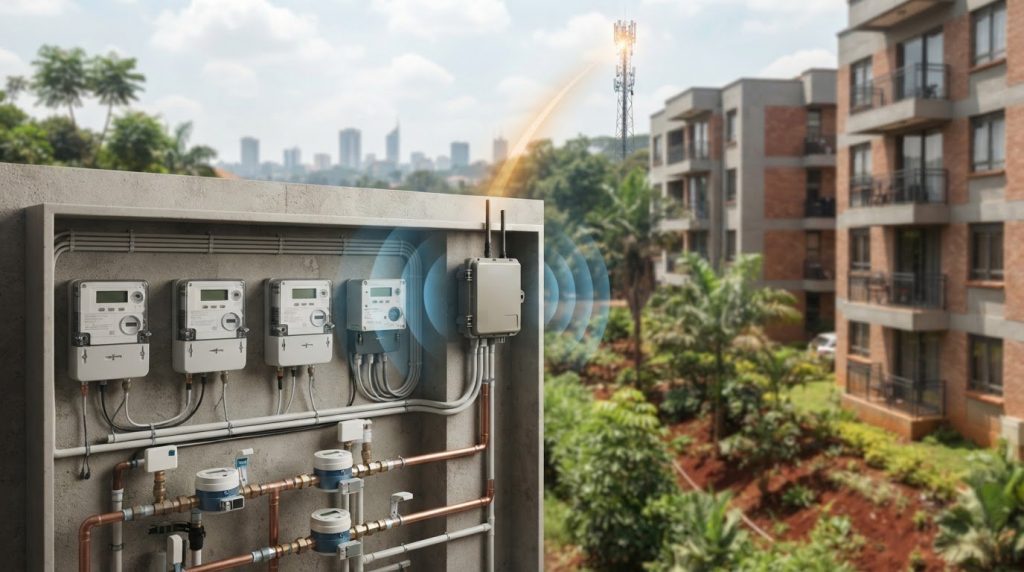
Prepaid token meters for electricity and water as submeters under KPLC
The strongest meter network may not be the one that connects every meter directly to cellular. In a Nairobi deployment, 4G vs LoRa meter connectivity depends on where meters are located, what signal reaches them, and how readings travel to the receiving platform. A LoRa radio link between a meter and a gateway is not the same as a LoRaWAN network, and neither is identical to 4G cellular backhaul.
4G and LoRa solve different parts of the connectivity problem. 4G can connect equipment to a mobile network, while LoRa can link devices over a local radio network. In some designs, a gateway combines local LoRa links with 4G backhaul instead of giving each meter its own cellular connection.
This guide explains how the options differ, when a hybrid approach may fit, and how to compare them against site layout, building materials, meter density, coverage, and operating needs. You’ll also find practical steps for assessing signal conditions across Nairobi properties and see where an Outdoor 4G-LoRa water meter gateway fits into a metering system.
Key Takeaways
- Compare the meter’s data route, site coverage, power needs, and required infrastructure when weighing 4G vs LoRa meter connectivity.
- Map meter locations and reporting needs before choosing a direct cellular link or a local radio link to a gateway.
- Assess single-site deployments differently from multi-building or geographically dispersed meter groups.
- Consider a combined approach when separating local meter communication from wider-area data transport suits the site.
- Assess how an Outdoor 4G-LoRa water meter gateway could fit your residential or commercial water metering requirements.
4G vs LoRa meter connectivity: what each technology does
Start with the job the connection must do. A meter needs a way to send readings, but the route depends on the meter, the site, and how data must reach its receiving platform. In 4G vs LoRa meter connectivity, the terms describe different parts of the network: 4G is a cellular network technology, while LoRa is a radio technology that can form part of a local communications link.
This distinction matters at a property with several meters. A meter might communicate directly over a mobile network, or it might send readings over a local LoRa link to a gateway that handles the onward connection. These are different system designs, not simply different radio settings. The better fit depends on coverage, site layout, reporting needs, and available infrastructure.
What 4G means in a meter deployment
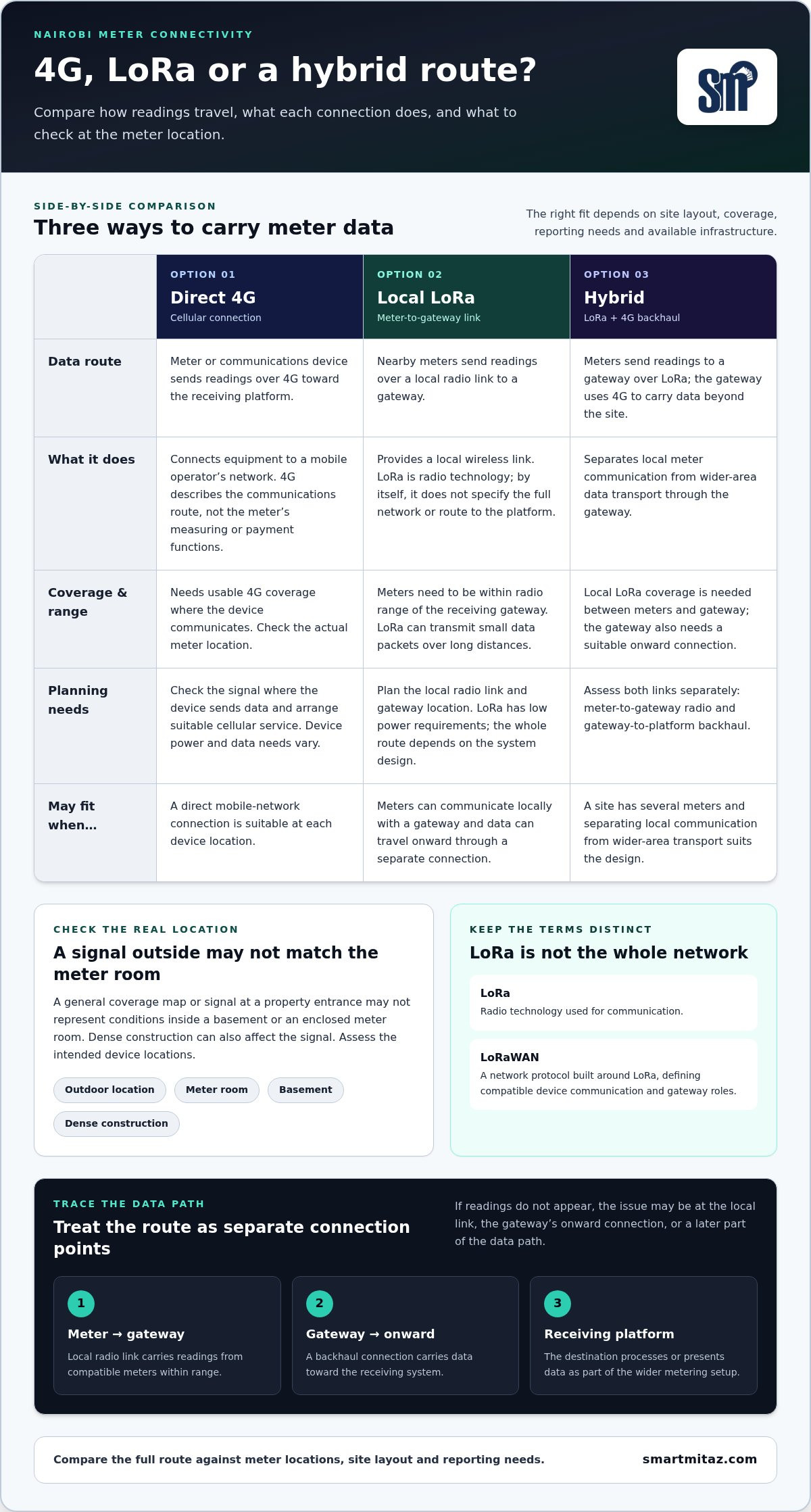
With 4G, a cellular-enabled meter or communications device sends data through a mobile operator’s network. The reading travels from the device over the cellular connection to the platform that receives or processes it. This route requires usable 4G coverage where the device communicates and a suitable service arrangement for that connection.
Assess coverage at the intended device locations. A signal available outdoors may not be equally reliable inside a meter room, basement, or building with dense construction. Check the actual locations rather than relying only on a general coverage map. Power and data requirements also vary by device and reporting pattern, so don’t assume every 4G meter uses power or sends data in the same way.
LoRa and LoRaWAN are related, but not interchangeable
LoRa technology uses radio to transmit small data packets over long distances with low power requirements. In metering, it can provide the local wireless link between a meter and another receiving device. The term LoRa describes the radio technology itself. It does not, by itself, specify the entire network or how data moves beyond that link.
LoRaWAN is a network protocol built around LoRa communication. It defines how compatible devices communicate within a LoRaWAN network, including the role of gateways that receive device transmissions and pass data onward. A system can use LoRa radio without being a LoRaWAN network. When assessing equipment, identify whether you mean the meter’s radio link, the network protocol, or the complete route to the platform.
For a practical comparison, separate two questions: how does the meter communicate nearby, and how does the data travel beyond the site? That framing helps clarify whether a deployment needs direct cellular communication, a local LoRa network, or a design that uses both. It also keeps the choice grounded in meter locations and the data path, rather than a generic ranking of technologies.
How 4G and LoRa carry meter data through a system
A meter’s reading and the route that carries it are separate parts of a metering system. The meter measures consumption and may handle other functions, such as prepayment. Connectivity moves selected data from the device to a receiving platform. Mapping each step helps clarify what the connection or gateway needs to do, without assuming every meter uses the same design.
A direct 4G route from meter to receiving platform
In a direct cellular design, a meter or its communications module sends readings over a 4G connection. The mobile network carries the data onward to the system that receives it. The destination and processing arrangement depend on the deployment. 4G describes the communications route, not the platform or the meter’s measurement and payment functions.
Plan around the actual meter location. A cellular device needs usable network coverage where it sends data and a suitable service arrangement. A signal at a property entrance does not necessarily represent conditions in a basement or enclosed meter room. Device connectivity, power needs, and reporting settings also affect the design and can differ between devices.
A LoRa meter link with a gateway
In a LoRa-based design, nearby meters transmit readings over a local radio link to a gateway. The gateway receives those transmissions and can pass the data onward using a separate connection, often called backhaul. Depending on the system architecture, that connection could use cellular connectivity such as 4G, or another suitable route.
For example, meters across a multi-unit property could send readings to a gateway within radio range. In a hybrid architecture, the gateway could then use a 4G connection to carry the collected data beyond the site. This is a possible system design, not a description of the precise data flow of every gateway. LoRaWAN systems also define network roles and communications rules. The LoRa Alliance Resource Hub provides further technical material on the protocol and its applications.
Think of the route as two links rather than one:
- Meter to gateway: the local radio link carries readings from compatible meters within range.
- Gateway onward: a backhaul connection carries data from the gateway toward its receiving system.
- Receiving platform: the destination processes or presents the data according to the wider metering setup.
This distinction is useful when troubleshooting. If readings don’t appear, the issue could be with the local meter-to-gateway link, the gateway’s onward connection, or a later part of the data path. Assess these as separate points rather than assuming “the network” is one connection.
For a water metering project, smartmitaz offers an Outdoor 4G-LoRa water meter gateway alongside residential and commercial smart prepaid water meters.
Compare 4G and LoRa for Nairobi meter deployments
For 4G vs LoRa meter connectivity, compare the route against the property, not a citywide assumption. A meter in an outdoor compound faces different radio conditions from one in a basement or enclosed utility room. 4G depends on mobile-network coverage at the device; LoRa depends on a local radio link between meters and a receiving point such as a gateway.
| Factor | Direct 4G | LoRa link |
|---|---|---|
| Coverage dependency | Usable mobile-network signal where the device communicates. | A suitable local radio path from the meter to a gateway or receiving point. |
| Data path | Meter communicates over the cellular network toward its receiving platform. | Meter sends data locally; a gateway may forward it beyond the site. |
| Power needs | Depend on the device design and how often it communicates. | Meter radio links are often designed for low-power communication; gateway power needs must also be planned. |
| Infrastructure | Cellular-capable devices and a suitable service arrangement. | Compatible meters and local receiving infrastructure, commonly including a gateway. |
Compare the factors that affect meter connectivity
Consider reporting frequency and data volume alongside signal. A device sending small readings periodically has different requirements from one transmitting more often or handling additional data. Power availability matters too: a meter’s communications design and a gateway’s power source can affect where each unit can be placed. With LoRa, gateway location is part of the network plan. With direct 4G, each cellular device needs its own viable connection and service arrangement. The recurring connectivity arrangement may differ as well: direct cellular is associated with connected devices, while a LoRa deployment may concentrate wider-area connectivity at gateway level. The exact setup depends on the architecture.
Assess signal conditions at Nairobi properties
Nairobi sites vary. A meter mounted outside a house, one behind a compound wall, and one in a basement may experience different conditions, even at the same property. Walls, distance, metal enclosures, and the layout between meters and receiving equipment can affect radio performance. Don’t treat a citywide coverage map or an outdoor signal reading as proof of reception at every meter location.
Assess representative locations before settling the design. Check the actual meter rooms, utility spaces, basements, and outdoor positions. Note obstacles and distances, then evaluate the intended communication route from those points. For a LoRa layout, include possible gateway positions and the path from each meter. For direct 4G, assess cellular reception where each device will operate. Record weak or obstructed locations so the deployment plan reflects site conditions.
A compact commercial property with accessible meter locations may suit a different arrangement from a multi-building estate with meters spread across enclosed spaces. Compare the infrastructure each option requires against the reporting needs and available power. This site-specific assessment gives you a sounder basis for choosing than assuming one technology works uniformly across Nairobi.
Choose a connectivity approach for your meter site
Choose the route after documenting where the meters sit and how readings need to reach their destination. The same 4G vs LoRa meter connectivity decision can lead to different answers for a detached home, an apartment block, or a commercial property. Use this sequence to narrow the options based on site conditions, not assumptions about what works across Nairobi.
Start with the property layout and reporting requirements
Map the meters, likely gateway positions, building materials, distances, available power, and access constraints. Record how often readings need to be collected and where they must be viewed. This turns a broad connectivity question into a practical site plan.
- Plot every meter location. Mark indoor meter rooms, basements, outdoor enclosures, and meters in separate blocks. Note walls, floors, metal cabinets, and other potential obstacles to radio links.
- Set the reporting requirement. Document the reading frequency, the data required, and the receiving system or users that need access. Reporting needs help determine whether the device and network arrangement are suitable.
- Identify the possible routes. Consider whether each meter can communicate over cellular from its own position, or whether local meter links to a gateway would suit the layout. A signal at the gate does not establish reception in an enclosed utility room.
Use a site assessment to narrow the options
For each candidate position, compare observed cellular reception with the proposed LoRa meter-to-gateway layout. Include gateway placement and power access in the property plan. Record where and how tests were made, along with obstructions and coverage assumptions. These observations make the connectivity design easier to review and adjust.
- Assess a single-site deployment. A standalone home in Nairobi may have one accessible meter location, while an apartment building may place meters in a shared basement or separate service areas. Assess the actual positions. Direct cellular can suit locations where individual device connectivity is practical; local radio and a gateway may suit a site-wide layout that supports aggregation.
- Assess a multi-building or commercial site. Map distances between blocks, meter clusters, and potential gateway locations. A local radio design depends on a workable path between meters and receiving equipment. A widely distributed group may need a different arrangement from meters concentrated in one building.
- Document results before finalising. Record signal observations, test locations, power availability, reporting needs, and weak points. Revisit the design if a meter location or gateway position changes.
Keep connectivity selection separate from choosing meter types, procurement, and installation planning. First define the data route and site requirements, then align the hardware and implementation decisions with that design. For a water-meter project, explore smart prepaid water metering hardware, including the Outdoor 4G-LoRa water meter gateway, as part of the system assessment.
When a combined 4G-LoRa gateway fits a metering system
A combined approach can make sense when meters need a local communications link and the site also needs a route for data to travel beyond that local network. Instead of treating connectivity as a single choice, the design separates the meter-to-gateway link from the gateway’s onward connection. This can suit multi-meter properties where meters are grouped across a defined area.
This architecture is not automatically the right fit. Its usefulness depends on meter locations, radio paths, gateway position, power access, and reporting requirements. A gateway adds a device and another point in the data path to plan for. Compare that infrastructure with the requirements of giving each meter its own cellular connection.
Recognise when a two-link architecture is relevant
Consider an apartment property or commercial site with several water meters in nearby buildings or service areas. A planned local network may let meters communicate with a gateway, which then connects the collected data to a wider-area network. In a hybrid design, that onward route could use cellular connectivity. The exact system depends on the equipment and network configuration, not simply on the presence of “4G” and “LoRa” in a product name.
Check whether meters can reach a practical gateway location and whether that location can support the onward data connection. If meters are widely separated, obstructed by building materials, or located where gateway access is difficult, aggregation may be less practical. Compare the proposed layout with direct cellular connectivity at the meter positions. The aim is a workable data path, not the use of both technologies for its own sake.
Connect the connectivity decision to smartmitaz hardware
For a water-meter deployment, smartmitaz offers an Outdoor 4G-LoRa water meter gateway, alongside residential and commercial smart prepaid water meters. The gateway is relevant to teams evaluating systems that involve both 4G and LoRa. Its product name alone does not specify a particular topology, supported meter count, coverage, compatibility, or performance. Base those decisions on the intended system design.
Before selecting a combined setup, define the meter locations, intended local communication path, onward connection, and where readings need to be received. Then assess how the gateway fits the planned arrangement and how the complete system will be powered and managed. This keeps the decision focused on deployment requirements rather than assuming a hybrid device will suit every property.
Use the same practical criteria for residential estates, apartment blocks, and commercial sites: meter density, layout, reporting needs, signal conditions, and infrastructure. A combined approach is most relevant when a local meter network and a separate wider-area connection solve distinct needs in the same deployment. Explore smartmitaz’s metering hardware, including the Outdoor 4G-LoRa water meter gateway, when assessing options for your water-meter system.
Turn your connectivity decision into a deployment plan
Make the next step a clear deployment brief. Record the communication approach, the assumptions behind it, and how the system will be evaluated before rollout. This gives property teams and technical stakeholders a shared reference as the metering project moves forward.
Use your 4G vs LoRa meter connectivity assessment to set practical acceptance criteria for the site. Define what successful data delivery means, which locations need priority, and what should happen if a reading doesn’t arrive as expected. Keep the criteria specific to the deployment and update them if the property layout or reporting needs change.
For water-meter projects, smartmitaz offers residential and commercial smart prepaid water meters, as well as the Outdoor 4G-LoRa water meter gateway. Explore smartmitaz metering hardware to identify options relevant to your system plan.
A documented plan makes the next decision easier. Set the requirements, then move forward with a clear basis for choosing the connectivity route.
Frequently Asked Questions
Can LoRa signals pass through concrete?
LoRa signals may pass through concrete, but reception depends on the building and device placement. A reinforced concrete wall between a meter and gateway can affect the link differently from an unreinforced wall. Distance, interference, and the meter room’s position matter too. In a Nairobi apartment block, don’t assume a gateway in a corridor will reach meters in a basement. Assess intended positions under real site conditions instead of relying on a fixed indoor range.
Does a 4G-connected meter need a SIM card?
Many cellular IoT devices use a SIM or embedded SIM to access a mobile operator network, but the arrangement depends on the device. A SIM is part of the connectivity setup, not the meter’s measurement hardware. The service subscription is also separate from the physical meter. Include the required cellular access arrangement in the system plan, and use the device documentation to identify its specific connectivity configuration and requirements.
What happens to meter readings during a network outage?
It depends on the device’s storage, retry, and recovery behaviour. Some systems may retain readings and send them after service returns; others may leave gaps in the data record. Don’t assume either behaviour for a particular meter or gateway. For a Nairobi property that needs an auditable consumption history, define outage handling and data continuity as design requirements, then ensure the system’s documented behaviour aligns with those needs.
Can LoRa connectivity be used without LoRaWAN?
Yes. LoRa is a radio modulation technology, while LoRaWAN is one network protocol that uses LoRa. A system may use LoRa radio with another architecture, depending on its design. The devices and receiving equipment still need compatible communications rules, even if the system is not LoRaWAN-based. Don’t infer the protocol from the word “LoRa” alone; identify it in the relevant equipment documentation before planning integration.
Does 4G connectivity always provide faster meter readings than LoRa?
No. A technology label alone doesn’t determine how quickly a reading reaches its destination. Device settings, network conditions, reporting intervals, and the receiving system all affect end-to-end timing. In 4G vs LoRa meter connectivity, a meter scheduled to send readings infrequently won’t necessarily report faster just because it uses cellular. Set the required reporting schedule first, then assess performance at the intended meter locations.
Can a metering system use more than one connectivity technology?
Yes. Some designs use one technology for a local meter link and another for the onward data route. That can suit a property where meters communicate locally and a separate connection carries data beyond the site. A gateway’s name alone does not establish that it supports a particular arrangement. Define the role of each link, compare the design with the equipment documentation, and test the complete reading path to the receiving platform.