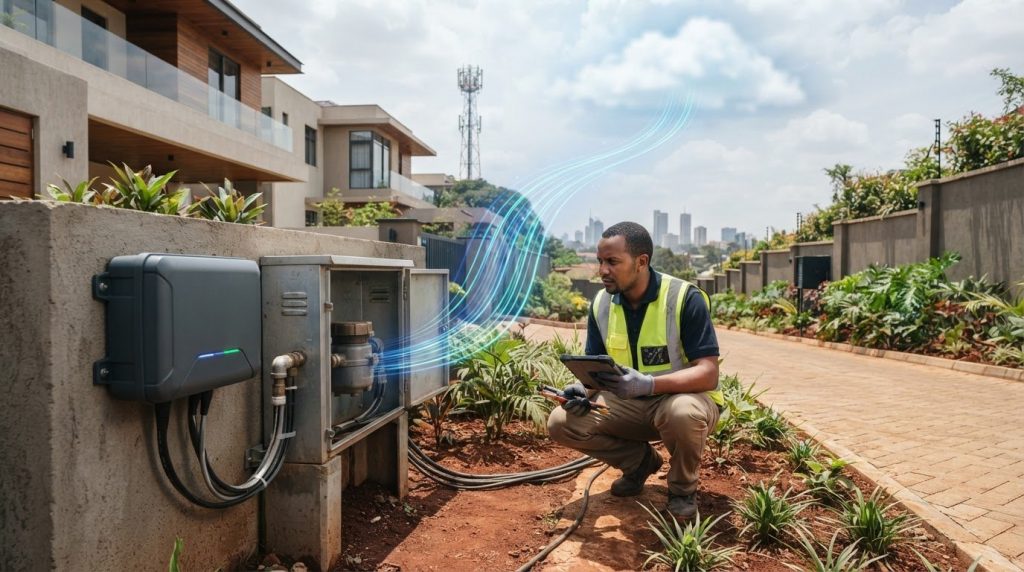
Outdoor Water Meter Gateway: How It Works and Where It Fits
A water meter can record consumption correctly and still leave a property without usable remote readings if the connection path doesn’t fit. An outdoor water meter gateway sits between compatible meters and a digital monitoring system: the meter measures water use, the gateway passes readings onward, and the platform presents the data for review. Each part has a separate role, and the link between them matters.
For a Nairobi property, outdoor placement and connectivity are practical considerations, not afterthoughts. The meter’s communication method, the gateway’s supported connections, the site environment and the receiving system all affect whether the setup will work together. A gateway isn’t a universal adapter for every meter or platform.
This guide explains how readings move through a metering system, how a gateway differs from a meter and monitoring platform, and which compatibility and site questions to assess before deployment. It also introduces smartmitaz’s Outdoor 4G-LoRa water meter gateway. Use the checks ahead to compare your property’s meters, site conditions and data requirements with the equipment specifications.
Key Takeaways
- Trace the data path from meter reading to gateway communication, transfer, and display in a receiving system.
- Use the outdoor water meter gateway fit checklist to document the meter interface, communication path, and receiving-system requirements.
- Record meter locations, mounting constraints, and the intended data destination before assessing an outdoor site in Nairobi.
- Check actual signal conditions at the proposed gateway location and record the findings for the system design.
- Compare the smartmitaz Outdoor 4G-LoRa water meter gateway with your meter and data-path requirements.
What an Outdoor Water Meter Gateway Does in a Smart Metering System
An outdoor water meter gateway connects water-meter data with a receiving system so readings can be communicated for digital monitoring. The meter measures water use; the gateway handles communication between the meter and the system that receives its readings. Keeping these roles distinct helps property teams assess each part of a metering setup without treating the gateway as a meter or a source of water.
A Smart meter can be part of a broader system for collecting and communicating utility data. For water monitoring, the full data path matters: a reading must be recorded, passed through a compatible communications component, and delivered to a system that can receive and present it. Equipment and connections vary by setup.
How a gateway differs from a water meter
Think of the meter as the measuring point, the gateway as the messenger, and the monitoring system as the place where information is reviewed. The meter records water usage. The gateway communicates readings onward. The receiving system displays or processes the data according to its capabilities.
A gateway doesn’t supply water or measure consumption by itself. The meter and gateway need a suitable way to exchange data, and the receiving system needs to accept it. If one part is incompatible, the reading may not reach its intended destination. Treat the three components as a connected chain, not interchangeable devices.
Who may use an outdoor water meter gateway
Residential and commercial property teams may consider gateway-based monitoring when they need readings communicated beyond the meter location. A residential property might have meters serving separate units or shared areas. A commercial site might have several metering points across its premises. The number of meters and the way they connect affect the system design.
Outdoor equipment may be relevant when meters are positioned outside, such as near a property boundary or in an external meter area. That placement shapes decisions about where communications equipment sits and how it connects with the meter and receiving system. Document the meter type, site layout, connectivity and intended data destination before selecting equipment.
For Nairobi property managers, remote readings can make water-use information available without relying only on visits to each meter. The value depends on the data being captured and delivered in a useful form, not simply on adding a gateway. smartmitaz sells an Outdoor 4G-LoRa water meter gateway, along with residential and commercial smart prepayment water meters. Assess the gateway in the context of the meter, communication link and receiving system.
How an Outdoor 4G-LoRa Water Meter Gateway Moves Data
Data path in brief: a compatible meter records water use, a gateway communicates the reading, a connection transfers it, and a receiving system displays or processes it. Each stage has a separate role. The meter interface and receiving system depend on the equipment selected, so the product name alone doesn’t describe how a specific setup connects.
The terms 4G and LoRa identify connectivity technologies, but they don’t by themselves explain the gateway’s full network arrangement. The selected equipment determines how meter data reaches the gateway and how data moves from there to its destination. Semtech’s overview of LoRa Technology in Smart Utilities describes LoRa’s use in smart utility applications, including water metering.
From water usage to a meter reading
The process begins at the meter, where water use is measured and recorded. To pass that reading onward, the gateway needs a compatible meter or meter interface. Start by checking the meter’s documentation for its data output or communication interface. The interface and reading method depend on the equipment, so don’t assume a particular connection method based on the gateway category alone.
For example, a property manager might want readings from a meter serving a shared garden. The meter records usage; the gateway’s role begins with communicating data made available through a compatible connection. The example illustrates the data path, not a specific connection method for that meter.
From gateway communication to usable monitoring data
Once the gateway receives or accesses a reading, it communicates the data onward. That communication step is separate from the software or platform that receives and displays the information. The destination must be able to accept the data in the form provided by the chosen equipment. Otherwise, a reading may not appear where the property team expects to review it.
When the receiving system is configured for the data, readings can support water-use monitoring across a property or other metering context. What users can view or do with that information depends on the receiving system and its configuration. Check the system requirements rather than assuming the gateway itself supplies a dashboard, alerts, or a particular software integration.
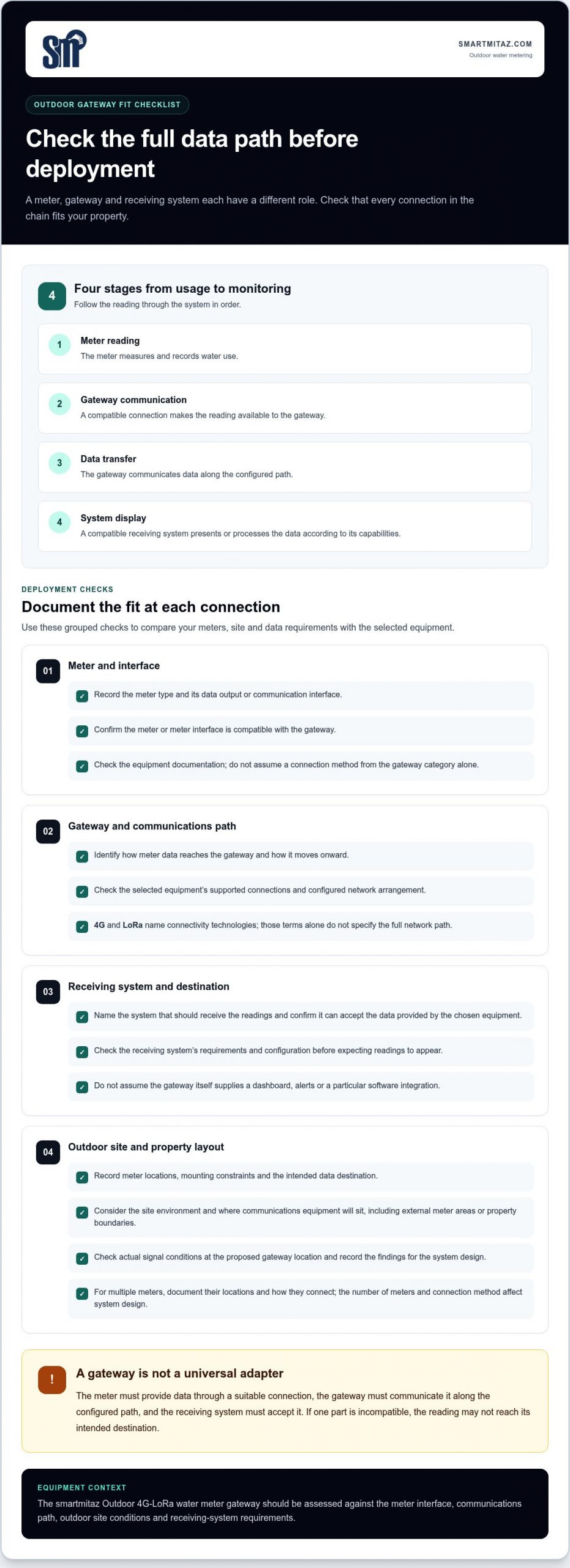
Follow the four stages
- Meter reading: The meter measures and records water use.
- Gateway communication: A compatible connection makes the reading available to the gateway.
- Data transfer: The gateway communicates the data along the configured path.
- System display: A compatible receiving system presents or processes the data according to its capabilities.
For an outdoor water meter gateway, evaluate all four stages together. Record the meter interface, how the gateway communicates, and where readings are intended to go. The Outdoor 4G-LoRa water meter gateway from smartmitaz is a hardware option for this type of system. Review the Outdoor 4G-LoRa water meter gateway as you map the meter-to-system path for your property.
How to Assess Gateway and Meter-System Fit
Assess fit across the full data path, not by matching a gateway label to a meter label. The key checks are the meter interface, the communications route, and the requirements of the system that will receive the readings. For a specific gateway, use its product documentation to confirm supported interfaces, network arrangement and software compatibility.
Keep the terms precise. LoRa and 4G refer to connectivity technologies, but the product name alone doesn’t explain which device communicates over each link or how the data reaches its destination. If a design specifies LoRaWAN, the LoRa Alliance overview of LoRaWAN explains the standardized protocol. Confirm the exact technology and network path in the system documentation rather than assuming every LoRa-based setup uses the same arrangement.
Check the meter interface and data destination
Start with the meter. Record its make and model, then note the communication interface or output stated in the meter documentation. If the interface isn’t documented, flag it as an open technical question. Next, identify the destination: for example, the platform or operational team expected to receive and use the readings. Compatibility depends on both ends communicating in a suitable format, not just on a physical connection between meter and gateway.
Match the setup to the property use case
For a single property, define which meter readings matter and who needs to review them. For a commercial site or managed property with multiple meters, map each meter to its location and intended data destination. Multiple meters don’t automatically mean a particular gateway capacity or user-management feature. Check those requirements against the equipment and system configuration.
| Requirement | Why it matters | What to document |
|---|---|---|
| Meter interface | The gateway needs a compatible way to receive meter data. | Meter make, model, documented output or interface, and any unresolved details. |
| Communication path | Connectivity labels don’t define the complete route from meter to destination. | Specified technologies, network arrangement, and where each connection is used. |
| Receiving system | The destination must be able to accept and use the transferred readings. | System name, data requirements, and the team responsible for reviewing information. |
| Property context | One meter at a residence differs from several meters across a managed site. | Meter locations, number of points in scope, intended users, and monitoring purpose. |
Use the table as a short technical brief before comparing equipment. Separate confirmed details from open questions, and don’t treat a feature of one gateway as a specification of another. For a residential or commercial project in Nairobi, this record helps show whether the meter, communication path and receiving system form a workable match, and which product details need to be resolved.
Prepare an Outdoor Gateway Site in Nairobi
Site readiness starts with a clear record of where readings originate, where communications equipment could be located, and where the data needs to go. For a Nairobi property, don’t assume connectivity at the office or elsewhere on the premises reflects conditions beside an outdoor meter. Assess the proposed location itself, then document the findings for the system-design review.
An outdoor water meter gateway must suit both the communication path and the physical conditions at its intended location. The word “outdoor” in a product category isn’t a substitute for checking environmental requirements against product specifications. Record the site conditions before selecting a mounting point or finalising the equipment choice.
Assess connectivity at the actual meter location
Signal conditions can differ between indoor and outdoor areas, and may vary across a property. Check connectivity where the gateway is proposed to sit, not only at the nearest building or entrance. Note walls, structures, distance from the intended connection point, and other site conditions that could affect the communications path. A citywide network-coverage claim can provide context, but it can’t establish signal conditions at one specific meter location.
Record the result and the method used to assess it. If there are multiple possible locations, tie each observation to its exact point. Include coverage limitations or other connectivity constraints in the system-design notes so they can be considered alongside the chosen network arrangement and receiving-system requirements.
Document mounting and operating conditions
Describe the proposed mounting point and its surroundings before equipment is selected. Include exposure to rain, direct sun, dust, and possible physical contact, along with access constraints and nearby infrastructure. Note whether the location is inside a meter enclosure or in an open area, and whether gates, property boundaries or site operations may restrict access.
These observations help compare site conditions with the product’s stated operating and environmental requirements. Don’t infer a weather or dust rating from the word “outdoor”; use the specifications for the particular equipment. Also record practical constraints, such as available mounting space and nearby obstacles, without assuming a specific mounting method or power arrangement.
Use a brief site record to keep the review actionable:
- Meter location: identify each meter in scope and its position on the property.
- Proposed gateway point: note the mounting area, nearby structures, access, and exposure.
- Connectivity observations: record conditions at the exact proposed point and any constraints.
- Data destination: name the intended receiving system or team.
- Specification checks: list the environmental and operating requirements to compare with product documentation.
This preparation gives residential and commercial property teams a site-specific starting point. To compare your site notes with a relevant hardware option, review the Outdoor 4G-LoRa water meter gateway.
Explore the smartmitaz Outdoor 4G-LoRa Water Meter Gateway
smartmitaz sells the Outdoor 4G-LoRa water meter gateway as part of its smart metering product range. In a metering setup, the gateway’s role is to communicate readings made available through a compatible interface and pass them to a receiving system. The product name identifies the connectivity technologies in its name, while the complete system design depends on the meter, network path and receiving system.
Where the gateway fits in a water-metering setup
Place the gateway between the meter data and its intended destination in your system plan. First, identify the meter or meters in scope and the interface through which readings are made available. Then map the communication path and name the receiving system or team. These decisions shape the design; a gateway should be assessed alongside the meter and destination.
The same framework applies to a single property or a broader residential or commercial metering context. A property manager may be planning for one reading point, while a managed site may have several. The number and location of meters, the communication arrangement, and the destination for readings can differ. Document these requirements rather than assuming that a setup suited to one property will transfer unchanged to another.
Move from understanding to product evaluation
Before evaluating the gateway for a project, bring together the details that affect the system as a whole. Separate information already documented from items that need product-specific verification. This gives your technical review a practical starting point and keeps general category information distinct from device specifications.
- Meter interface: Record the meter make and model, plus its documented data interface.
- Connectivity: Map how data is intended to travel between the meter, gateway, and destination. Don’t infer the arrangement from “4G-LoRa” alone.
- Data destination: Identify the system expected to receive readings and the team that will use them.
- Site context: Note the meter locations and any site conditions relevant to the planned gateway position.
Use this information to assess the Outdoor 4G-LoRa water meter gateway against your proposed system design. Compare compatibility, environmental requirements and other technical details with the relevant product specifications, rather than assuming them from a product category or another gateway’s features.
Explore the smartmitaz gateway and compare it with your meter interface, connectivity plan, and intended data destination.
Build a Clear Brief for Your Next Metering Decision
Turn your site notes into a short project brief before selecting an outdoor water meter gateway. Include the meters in scope, their documented interfaces, the proposed gateway location, connectivity observations, and the system or team that needs the readings. This gives property decision-makers and technical teams a shared reference for evaluating the complete data path.
Use that brief to distinguish what the property needs from what a particular device supports. The smartmitaz Outdoor 4G-LoRa water meter gateway is one hardware option to consider. smartmitaz also sells residential and commercial smart prepayment water meters, which may form part of a broader property metering plan. Base decisions on your setup requirements and the relevant product specifications.
With your system brief in hand, explore the smartmitaz Outdoor 4G-LoRa water meter gateway and assess it against your metering plan.
Frequently Asked Questions
What is an outdoor water meter gateway?
An outdoor water meter gateway is a communications device used to pass water-meter readings to a receiving system. The meter measures usage; the gateway communicates data rather than measuring water or supplying it. For example, a property team could use gateway-based metering to make readings available beyond a meter location. The exact data route depends on the meter interface, gateway configuration, and destination system.
Can a water meter gateway work with an existing water meter?
It can work with an existing meter if the meter provides data through an interface the gateway supports. Check the meter’s make and model, then review its documentation for a communication output or interface. For example, a meter that only displays readings may need a different arrangement from one designed to share data electronically. Compatibility also depends on whether the receiving system accepts the transferred information.
Does an outdoor water meter gateway need an internet connection?
Remote monitoring requires a suitable communication route from the gateway to the receiving system, but that route depends on the equipment and system design. A 4G-based connection may use cellular data, while another setup may use a different path. Identify where the readings must go and document the required network access before planning remote monitoring.
What is the difference between 4G and LoRa in a meter gateway?
4G vs LoRa meter connectivity involves different technologies: 4G is a cellular network technology, while LoRa is a radio communication technology used for connected devices. They describe different communication options, but the names alone don’t show how a particular gateway uses them. The system design determines which devices communicate over each link and how readings reach their destination. Review the gateway and receiving-system documentation before assuming a specific network arrangement.
Can one gateway connect multiple water meters?
That depends on the gateway’s supported interfaces and capacity, along with how the meters provide data. Don’t assume a gateway supports several meters simply because a property has multiple readings to collect. For a managed building, list each meter’s make, model, location, and documented interface. Then compare that information with the gateway’s specifications and the receiving system’s requirements to assess the proposed configuration.
How do I check whether a gateway suits a Nairobi property?
Start with the property’s meter documentation and the intended destination for readings. Record the proposed gateway location, then check actual connectivity there rather than relying on conditions elsewhere in Nairobi or on a general coverage claim. Note nearby structures and access constraints. Compare site conditions and the required communication path with product specifications, including the supported meter interface and receiving-system compatibility.
Does an outdoor water meter gateway need a separate power source?
Power requirements vary by gateway, so the product’s technical documentation is the reliable reference. Check whether the listed power arrangement suits the proposed site and whether the required supply is available at the intended location. Don’t infer a power source from the words “outdoor,” “4G,” or “LoRa.” Include power availability alongside the meter interface, connectivity route, and receiving-system needs in your equipment assessment.
Planning a water metering project in Nairobi? Explore smartmitaz’s Outdoor 4G-LoRa water meter gateway and compare it with your meter, site and data requirements.