Single Phase Smart Prepayment Meter: A Nairobi Buyer’s Guide
Choosing a single phase smart prepayment meter starts with the property’s electrical setup and the way you plan to manage metering day to day, not with the longest feature list.
For a Nairobi property owner or manager, the key questions are whether single-phase metering fits the supply, which features the project actually needs, and how prepaid credit will be managed. The right choice depends on the property’s requirements, not product claims alone.
This guide explains what to compare, including phase type, hardware format and operating needs. It also distinguishes smartmitaz’s Single Phase Smart Prepayment Meter from its Three Phase Smart Prepayment Meter and DIN rail Single Phase Smart Prepayment Meter. Use these criteria to identify the relevant product category and the technical details to review before making a selection.
Key Takeaways
- Match the meter’s phase to the property’s electrical arrangement before comparing features.
- Use product documentation to compare model-specific details such as installation form, display, credit workflow, communications and standards.
- A single phase smart prepayment meter and a three-phase option serve different electrical arrangements. Compare each with the property’s requirements.
- Assess prepaid and smart-enabled options by the workflow you need. Don’t assume every model offers the same functions.
- Document the property setup and operating needs to create a practical basis for evaluating meter options in Nairobi.
Is a Single Phase Smart Prepayment Meter Right for Your Nairobi Property?
A single-phase smart prepayment meter is electricity metering hardware designed for a single-phase supply and prepaid use. Suitability depends first on the property’s electrical arrangement, then on how electricity use and credit need to be managed. A home, shop or rental unit may be a useful context for assessing this type of meter, but the property category alone doesn’t establish a match.
Keep three questions separate. Phase describes the electrical supply the meter is designed to measure. Prepayment describes how credit is managed before electricity consumption is billed. Smart capabilities are digital metering functions that vary by model. The general Smart meter overview discusses the range of functions and communications associated with smart metering. Check the product documentation rather than assuming a particular capability is included.
Quotable summary: Phase suitability must match the property’s electrical setup; property size alone can’t determine the right meter.
Which properties should assess a single-phase meter?
Residential properties and smaller premises can be practical settings for evaluating single-phase metering, but they aren’t automatically suitable. A compact flat could have a different supply arrangement from a nearby shop, while a larger property may still have a single-phase supply. Floor area, number of rooms and property type don’t identify the phase.
Start with the actual supply arrangement. Review available electrical records or have the existing setup assessed by a qualified electrical professional. Note whether the meter is for the whole property or a separately metered unit, and record its intended use. For a Nairobi rental property, for example, a landlord’s metering needs may differ from those of an owner-occupied home. Establish the supply first, then compare products with the documented arrangement.
What does prepayment add to electricity metering?
With prepaid metering, credit is managed before electricity consumption is billed. This can suit a workflow where a property manager or user administers electricity credit for a particular metered space. The meter measures electricity and supports the relevant prepaid arrangement; it isn’t itself an electricity supplier or utility billing service.
How credit is purchased or loaded depends on the metering arrangement. Identify who will manage credit, who will use the metered space, and what workflow the property needs. Then check the product documentation to see whether the meter’s supported functions fit that workflow.
Before selecting hardware, write down the supply phase, the metering boundary and who is responsible for managing credit. These details help distinguish an electrical fit from a product that only appears suitable based on property size or a broad feature description.
Which Single Phase Smart Prepayment Meter Specifications Should You Compare?
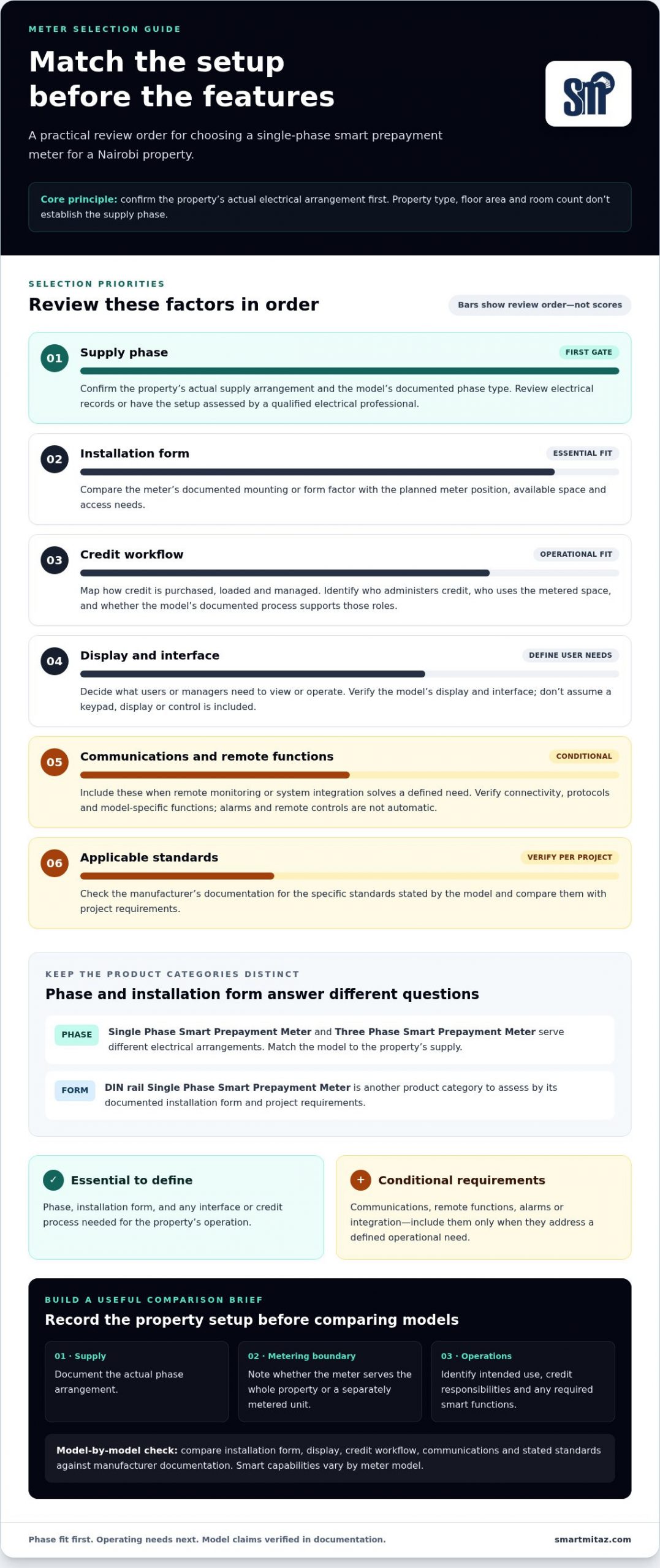
Compare meters against a written project brief, not a feature list in isolation. Separate essentials, such as the required phase and physical installation form, from optional functions that matter only if they support your operating workflow. Use the manufacturer’s documentation for each model’s technical values and capabilities. A value published for one meter shouldn’t be treated as standard across the category.
Smart features vary by meter model, so verify each capability against the manufacturer’s documentation.
Phase: The required phase arrangement for the property. Confirm the model’s documented phase type.
Installation form: The required mounting or form factor. Compare the documented form with the available meter position and project plan.
Display and interface: What users or managers need to view or operate. Verify the display and interface provided by the model.
Credit workflow: How credit is loaded and managed. Check the documented process and user roles.
Communications: Relevant when remote monitoring or system integration is part of the project. Verify the protocol and connectivity details.
Standards: Any applicable project requirement. Check the model documentation for the specific standards it states.
How should you assess phase, installation, and interface?
Start with the property’s supply arrangement and the meter’s intended position. Record the available space, access needs and installation form required by the project, then compare them with the manufacturer’s specifications. For the interface, define what users must see or do. Don’t assume a display, keypad or other control is included because a product is described as smart or prepaid.
Which prepaid and smart functions matter to your workflow?
Map the credit process from purchase to loading and use. Identify who manages credit, who needs access, and what consumption information supports property operations. If remote monitoring or integration is required, make connectivity a project requirement and compare documented protocols and functions. Alarms and remote controls are model-specific, not automatic features of every smart prepayment meter.
Prioritise requirements in two groups:
- Essential: Phase, installation form, and any interface or credit process needed for the property’s operation.
- Conditional: Communications, remote functions, alarms or integration, included only when they solve a defined operational need.
This distinction keeps the comparison focused. A property manager may need a defined way to administer credit but have no need for remote monitoring. In that case, prioritise the documented credit workflow. If remote access or integration is essential, list it separately and verify the exact capability and its requirements instead of relying on a general “smart” label.
Use the same checklist for each single phase smart prepayment meter under consideration, and note the source document beside each model-specific answer. To compare the relevant hardware category, review smartmitaz’s single-phase meter options.
How Do Single-Phase Prepayment Meter Options Differ?
Compare options across two dimensions: how prepaid credit is managed and how the meter is configured for the property. A conventional prepaid meter may support a prepaid workflow without remote communications. A smart-enabled model may add documented digital functions, but “smart” alone doesn’t specify which ones. Installation form is another consideration, not a measure of phase or smart capability.
Use this table to turn the property’s needs into model-specific questions. Treat each feature as something to verify in the manufacturer’s documentation, not as a standard shared by all meters.
| Buyer need | Option to investigate | Specification to verify |
|---|---|---|
| Prepaid credit management | Conventional prepaid meter | Documented credit-loading process and user interface |
| Digital functions or monitoring | Smart-enabled prepaid model | Exact functions, communication method and any system requirements |
| Existing meter arrangement | Standard or DIN rail form | Model’s installation form and physical requirements |
| Property supply needs | Single-phase model | Documented phase type and applicable electrical specifications |
Smart functions versus basic prepaid operation
Prepayment describes how credit is managed; communications describe whether and how a meter exchanges information with another device or system. These are separate evaluation points. Don’t assume a prepaid meter supports remote top-ups, alerts or live monitoring. Compare a manual credit-entry process with a connected workflow only when product documentation describes the relevant functions and requirements.
For example, a property manager may need a defined way to administer credit but have no need for remote monitoring. Prioritise the documented credit workflow in that case. If remote access or integration is essential, list it as a separate requirement and verify the exact capability rather than relying on a general “smart” label.
Standard and DIN rail single-phase meter forms
Installation form should match the existing arrangement or project design. DIN rail is a distinct product configuration, not a different phase type. Check the manufacturer’s documentation for physical dimensions, wiring and installation requirements before deciding whether a form suits a particular location. Don’t infer these details from the product name alone.
smartmitaz offers the Single Phase Smart Prepayment Meter and the separately named DIN rail Single Phase Smart Prepayment Meter. Compare each with the property’s documented phase and form-factor requirements. Neither the shared single-phase description nor the DIN rail label establishes dimensions, wiring details or compatibility without model-specific technical information.
There’s no universal ranking. Select the option that aligns with the property’s supply, intended installation form and credit workflow, then compare any additional smart functions that serve a defined operational need.
What Should Nairobi Buyers Check Before Selecting a Meter?
Build the decision from the property outward. In Nairobi, a home, apartment block, shop or rental unit may have different metering boundaries and management needs, so define the project before comparing products. A clear brief separates essential electrical requirements from optional functions and gives decision-makers a consistent basis for reviewing model documentation.
Checklist summary: Verify the supply, installation form, operating workflow, communications needs and supporting documentation before selecting a meter.
Prepare a property and operating-requirements brief
Record how the space is used and who will manage its meter. For a multi-unit property, identify whether the project concerns a shared supply or a separately managed space. Describe the intended prepaid workflow and what users need to see or do. Don’t assume property type or size determines electrical suitability.
- Survey the property. Note the property type, intended metering point, existing meter arrangement and available project information. Record which areas or users the meter is intended to serve.
- Set the operating objective. Define how credit will be managed, who will be responsible for it, and what consumption information users or administrators need. Identify any user-support process the property plans to provide.
- Name the decision-maker. Assign responsibility for meter operations and document who will manage the prepaid workflow. This is especially useful where tenants, owners and property managers have different roles.
Review documentation and deployment dependencies
Use the brief to compare the project with the technical information for each candidate model. Match its documented phase and installation form to the property requirements. Treat connectivity or integration as a deployment dependency only when the product documentation describes the required capabilities. A product label alone doesn’t establish technical fit.
- Match the electrical and physical requirements. Compare the documented phase type and installation form with the project brief. Use manufacturer documentation for model-specific technical values, dimensions, wiring details and interfaces.
- Check applicable requirements. Before relying on a Kenyan standard, regulatory requirement or utility interface, consult current publications from the relevant Kenyan regulator, standards body and utility. Confirm that the requirement applies to the specific project; don’t infer it from an unrelated product page.
- Plan deployment dependencies. List any required connectivity, system integration, user access or operational handover. Include only capabilities supported by the product’s documentation, and note what the property team must prepare around the meter.
Keep the completed brief with the product information. It creates a practical comparison record for a Nairobi property and helps prevent optional features from overshadowing supply, form and workflow requirements. For hardware options to assess against your project brief, explore smartmitaz’s single-phase prepayment meters.
Explore smartmitaz’s Single Phase Smart Prepayment Meter
Once you’ve documented the property’s supply arrangement, meter location and prepaid operating needs, compare them with the available product options. smartmitaz offers the Single Phase Smart Prepayment Meter for buyers assessing a single phase smart prepayment meter for a Nairobi property. The product name identifies it as a single-phase prepayment meter; it doesn’t, by itself, establish specific functions or technical compatibility.
Match the product category to your selection criteria
Use your project brief to keep the decision grounded. Check that the required phase, installation form and operating workflow are documented for the meter you’re evaluating. Keep the product options distinct: smartmitaz also offers a Three Phase Smart Prepayment Meter and a DIN rail Single Phase Smart Prepayment Meter. The three-phase option is a different phase category; the DIN rail option is separately named by its installation form. Neither distinction establishes dimensions, wiring or compatibility.
Before narrowing your choice, make sure your requirements cover:
- Supply: The phase arrangement recorded for the property.
- Form: The required meter configuration based on the existing arrangement and project design.
- Workflow: Who will manage prepaid credit and what users need to access.
- Functions: Any display, communication or other capability that the operation genuinely needs.
- Evidence: Manufacturer documentation that supports the model-specific technical details and any applicable requirements.
This process keeps the selection focused on fit rather than assumptions. For example, a project that needs a particular installation form should assess it separately from phase type. A requirement for remote communication should also be treated as a distinct capability, not inferred from the word “smart.” Use published product information for any function you plan to rely on.
Move from comparison to a practical next step
Prepare a concise procurement brief with the property’s supply details, intended metering point, preferred form, prepaid workflow and any required user or system functions. Keep relevant property records and manufacturer documentation together. This gives the evaluation a clear basis and makes it easier to identify details that need technical review before procurement planning proceeds.
Review the product information against that brief, without assuming specifications, connectivity, certifications, pricing, warranties or installation support that aren’t stated in the published details. Explore the smartmitaz Single Phase Smart Prepayment Meter as a product option for your documented requirements.
Turn Your Meter Requirements Into a Clear Next Step
Keep your property brief and product documentation together as you move from comparison to procurement planning. They provide a practical reference for evaluating a single phase smart prepayment meter against the project’s needs, rather than relying on a feature label or assumption. Use documented requirements to guide the next decision.
smartmitaz offers the Single Phase Smart Prepayment Meter, alongside a Three Phase Smart Prepayment Meter and a DIN rail Single Phase Smart Prepayment Meter. Treat these as distinct product options and match the relevant category to your property and metering plan.
Take the next step by reviewing the product information against your documented requirements. Explore smartmitaz’s Single Phase Smart Prepayment Meter and move forward with a clearer basis for your selection.
Frequently Asked Questions
Is a single-phase smart prepayment meter suitable for every home?
No. A single phase smart prepayment meter may not fit a home if its supply or metering arrangement requires a different configuration. For example, a house with a separate unit or a modified electrical setup needs its own requirements reviewed, regardless of the building’s size or age. Use available electrical records and a site assessment to establish the arrangement, then compare model documentation for suitability.
What is the difference between a prepaid meter and a smart prepaid meter?
A prepaid meter manages electricity credit before consumption is billed; “smart” describes additional capabilities that depend on the specific model and system. For a rental property, the practical difference may be whether the setup supports the required credit process or also provides a documented way to access readings remotely. Don’t assume remote readings, alerts or automatic credit handling are included. Compare only functions stated for the exact model.
Can a single-phase prepaid meter work without internet connectivity?
It depends on the meter and the wider metering arrangement. A local credit-entry process may not need internet, while functions that exchange data with another system may depend on a communication link. For a Nairobi property with unreliable connectivity at the meter location, treat internet access as a deployment question, not a default requirement. Check the model’s documentation for offline operation and which functions are affected if communication is unavailable.
How do I choose between a standard and DIN rail single-phase prepayment meter?
Compare the documented form and installation requirements with the planned meter position. DIN rail identifies a form factor, not a different phase. For example, replacing a meter in an existing enclosure may involve different physical constraints from planning a new electrical panel. Review the exact model’s dimensions, mounting and wiring information before deciding. Don’t assume a standard or DIN rail meter will fit an existing location based on its name alone.
Does a smart prepayment meter include a keypad or customer interface?
Not necessarily. Interface arrangements vary: one product may have a keypad, while another may use a different documented method for user interaction. If occupants need to enter credit or view information at the meter, make those tasks explicit in the property’s operating brief. Then review the product instructions and technical details for the exact interface. Don’t assume a keypad, display, mobile app or remote interface is included because the product is described as “smart.”
What should Nairobi property managers prepare before selecting a single-phase meter?
Prepare records showing the property’s supply and existing meter arrangement, along with a brief on intended users and who will manage credit. For a building with rented units, note which spaces the project covers and what information residents or administrators need. List planned communications or system integration separately. Before procurement, verify applicable standards and utility interfaces using current, authoritative Kenya-specific sources rather than relying on general product descriptions.
[…] communications component, not an electricity meter. For household electricity, compare the Single Phase Smart Prepayment Meter with the property’s electrical setup. For a three-phase supply, consider the Three Phase Smart […]
[…] offers an Outdoor 4G-LoRa water meter gateway for water-metering setups and a Single Phase Smart Prepayment Meter for single-phase electricity needs. These products address different monitoring requirements: […]