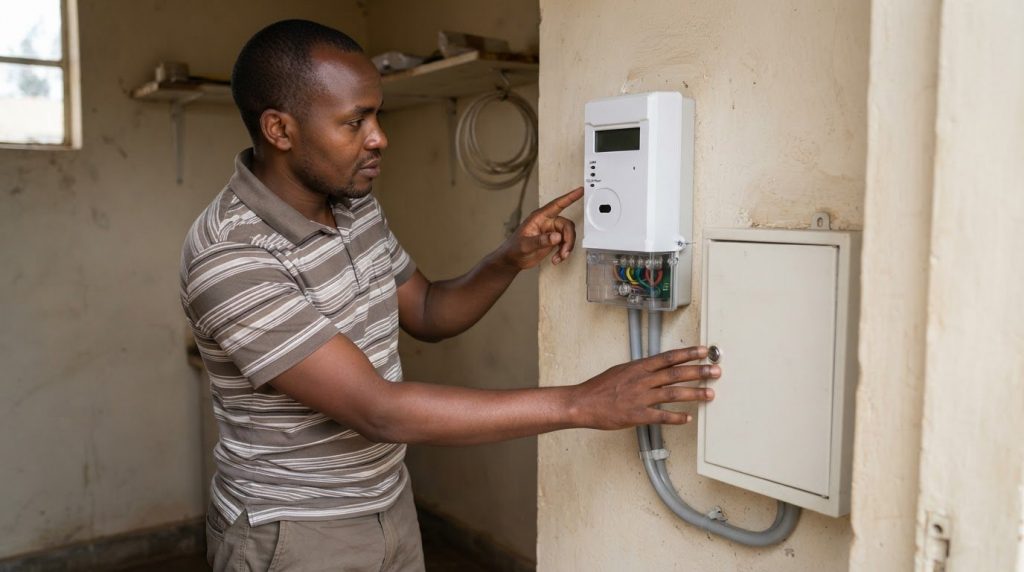
Prepaid Meter Compatibility for Your Home and Wiring
A prepaid meter can suit your home if its type matches your electrical supply and existing wiring. The main prepaid meter compatibility questions are whether your home uses single-phase or three-phase power, what infrastructure is already in place, and how the meter works when credit runs out. These questions lead to the key decision: matching the meter to your home’s setup.
It’s reasonable to want a clear answer before choosing a meter. This guide addresses prepaid meter compatibility questions by explaining how to assess your home’s supply and wiring, what existing metering infrastructure means for an upgrade, and how meter types affect fit. You’ll also learn what to expect when credit runs out and why three-phase capacity matters when selecting a meter. Use these points to identify which setup aligns with your home.
Key Takeaways
- Match the meter type to your home’s electrical supply before choosing a prepaid setup.
- Understand what happens when credit runs out and how token entry can affect reconnection.
- Assess existing wiring and metering infrastructure to see what an upgrade may involve.
- Compare single-phase and three-phase options to identify the right capacity for your property.
Automatic supply cut-off when credit runs out
A prepaid electricity meter tracks credit as the home uses energy. When the balance runs out, the meter can automatically cut off supply. Monitor the meter and recharge before the credit reaches zero. In a Nairobi home, planning a recharge can help prevent an unexpected interruption during everyday use.
Check the balance regularly rather than relying only on a low-credit beep. On a Clou meter, code 01 checks remaining tokens, while 004 checks total energy. These readings help distinguish unused recharge tokens from energy already consumed. Use the meter’s own display and instructions to interpret its balance correctly.
If a recharge token is rejected, enter the correct 20-digit token carefully. Check each digit against the receipt, then follow the meter’s entry sequence. Avoid repeating a token with a transcription error. Tokens expire after one year, so use valid credit promptly and retain the receipt until the meter accepts it.
Token order can also affect acceptance. A prepaid meter loads tokens in the order they were bought. If 10 more tokens have been purchased, an earlier token may no longer be accepted. Enter purchased tokens in sequence, especially when several recharges are waiting to be loaded.
A beep can signal low credit, but the alert procedure depends on the meter type. On a Hexing meter, pressing 812 followed by the hash key disables the beep. Treat that action as an alert setting, not a recharge. The balance still needs attention before the supply cuts off.
If you rent, agree with the landlord on who monitors and tops up the meter. Clarify whether the tenant handles recharge tokens or reports a rejected entry. Clear responsibilities help prevent avoidable interruptions and ensure the people managing the meter can track household electricity use.
The Meter Man says utility metering services can be migrated within a week, subject to the current supplier providing the relevant information. The Meter Man also says a prepaid-meter minimum charge is payable with the first transaction on the meter every month when applicable.
Suitability for homes and multiple dwellings
Start with the property’s layout. In a standalone Nairobi home, one meter may serve the household’s electricity supply. In an apartment building, separate meters can distinguish each dwelling’s consumption from shared areas such as corridors or security lighting. The right arrangement depends on how the wiring separates those loads.
In a rented home, clarify who manages payment and meter access. A landlord might oversee a meter serving shared spaces, while tenants manage their individual household accounts. Agree on these responsibilities before installation to reduce disputes about shared consumption and recharge duties.
In a multi-unit property, map the supply before deciding where meters belong. Identify each unit’s incoming circuit and separate it from communal circuits. If one meter serves several homes, its readings won’t automatically show each household’s individual use. A separate meter for each dwelling can make consumption allocation clearer.
A typical 20-unit apartment block in Kenya can usually have submeter installation completed in one to two days. That example helps property managers plan the work, but the building’s wiring layout remains important. Record which circuits serve each unit and common area so the meter arrangement reflects the actual electrical distribution.
Use these checks to assess fit:
- Identify whether the property is a standalone home or a multi-unit building.
- Trace the circuits serving each dwelling and shared area.
- Set clear responsibility for payment, access, and meter readings.
- Choose an arrangement that separates household use from communal consumption.
For a home focused on its own electricity use, assess the household supply and wiring. For an apartment block, include unit boundaries and common loads in the same decision. Review meter compatibility considerations as you compare the setup that fits your property.
Existing infrastructure and upgrade needs
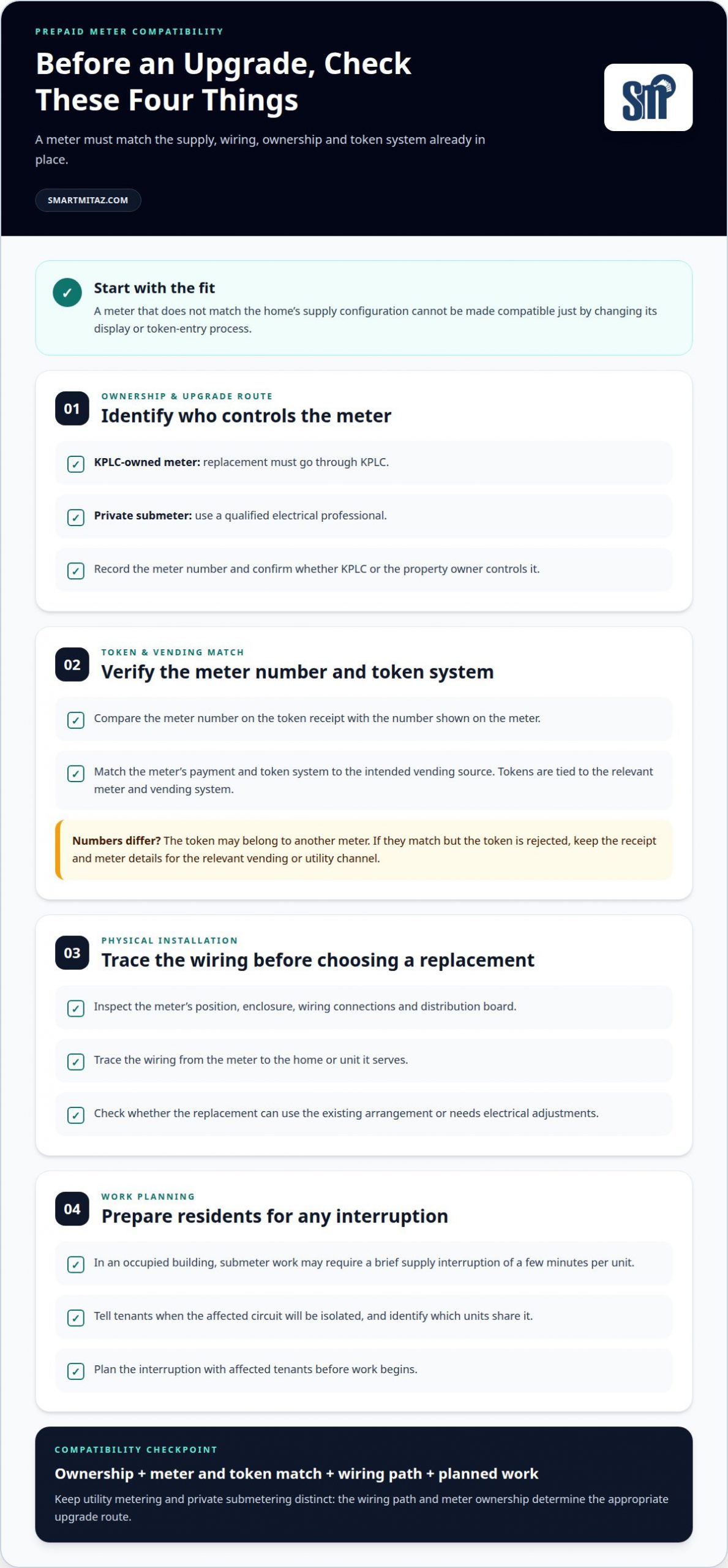
To check whether a prepaid meter accepts a KPLC token, compare the meter number on the token receipt with the number shown on the meter. Tokens are tied to the relevant meter and vending system, so don’t assume a token issued for one setup will work with another.
A prepaid meter can be replaced or upgraded in Kenya. For a KPLC-owned meter, the replacement must go through KPLC. For a private submeter, use a qualified electrical professional.
Before changing a private meter, inspect its position, enclosure, wiring connections, and distribution board. These determine whether the replacement can use the existing arrangement or needs electrical adjustments. A meter that doesn’t match the supply configuration cannot be made compatible simply by changing its display or token-entry process.
In an occupied building, submeter work may require a brief supply interruption of a few minutes per unit. Tell tenants when the affected circuit will be isolated and identify which units share it. This helps residents plan around the temporary power loss and reduces confusion about the work.
Use a simple preparation sequence:
- Record the meter number and identify whether KPLC or the property owner controls it.
- Trace the wiring from the meter to the relevant home or unit.
- Match the meter’s payment and token system to the intended vending source.
- Plan any interruption with affected tenants before work begins.
If a token doesn’t work, compare the receipt with the meter number shown on the display before trying again. If the numbers differ, the token may belong to another meter. If they match but the meter rejects the token, keep the receipt and meter details ready when contacting the relevant vending or utility channel.
Keep utility metering separate from private submetering in your plan. A KPLC meter serves its utility arrangement, while a private submeter tracks a downstream circuit or dwelling. The wiring path and meter ownership determine the appropriate upgrade route.
Meter types and three-phase capacity
KPLC prepaid tokens aren’t interchangeable across all meter brands and models. Use the token system assigned to the specific meter number. A matching prepaid label alone does not establish compatibility.
For a KPLC supply, compatibility depends on the meter assigned to the account and its token system. Single-phase and three-phase describe supply configurations, not token compatibility. Match the meter to the supply and account rather than choosing by brand name alone.
Find the meter number and manufacturer on its identification label or screen. The model may appear on the same label or in the displayed information. Compare those details with the meter information on your purchase receipt or account record.
If a KPLC token is rejected, compare the meter number on the receipt with the number displayed on the meter. Enter the token exactly as issued, following the meter’s prompts, and keep the receipt. A mismatch may mean the token was issued for another meter.
Three-phase capacity matters when the property has a three-phase supply. A single-phase meter is intended for a different configuration, so choosing by appearance or household size alone can lead to a mismatch. Check the existing meter and incoming supply before buying. In a building with different unit arrangements, assess each connection separately.
Reduce safety and fraud risks by checking the meter’s identification label, serial details, and purchase documentation before accepting it. Don’t share tokens or account credentials with people who don’t manage the supply. Keep wiring work separate from token entry, and use a qualified electrical professional for physical meter work. Never open an energised meter enclosure yourself.
Use this quick comparison before selecting a meter:
- Match the meter number to the account and token receipt.
- Identify whether the supply is single-phase or three-phase.
- Record the manufacturer and model from the meter label.
- Keep proof of purchase and token records together.
Match the meter type to your supply before purchase. Explore prepayment meter options for single-phase and three-phase setups.
A prepaid meter is compatible with KPLC when it is assigned to the account and uses the token system for that specific meter. Choose a single-phase or three-phase meter to match the property’s supply. Phase type alone does not establish token compatibility.
Smartmitaz: Outdoor 4G-LoRa water meter gateway
smartmitaz offers the Outdoor 4G-LoRa water meter gateway for water-meter setups that require an outdoor gateway. For electricity, match the meter category to the home’s supply: single-phase homes can consider a Single Phase Smart Prepayment Meter, while three-phase setups can consider a Three Phase Smart Prepayment Meter. These are separate choices from water metering.
For residential water metering, smartmitaz also offers a Residential Smart Prepayment Water Meter. Identify whether your priority is electricity or water, then compare the relevant meter category with your property’s existing supply and wiring. This keeps the selection focused on the type of utility being metered and the configuration already in place.
For product information, visit smartmitaz.com.
Choose a Meter That Fits Your Next Step
Make the decision practical: record your supply configuration, the meter’s identifying details, and the circuits it needs to serve. This separates product selection from installation planning and makes the next conversation more focused. Compatibility depends not only on whether a meter is prepaid, but also on the property’s electrical arrangement and the utility being measured.
For electricity setups, smartmitaz offers Single Phase and Three Phase Smart Prepayment Meters. For water monitoring, it offers an Outdoor 4G-LoRa water meter gateway. Use those categories to frame your prepaid meter compatibility questions and identify which product type is relevant to your property.
Move forward with the information you’ve gathered. Ask smartmitaz about meter compatibility and explore the product category that matches your setup. A clear starting point makes the next decision easier, so take the step that best fits your home.
Frequently Asked Questions
Can I install this meter in my own home?
Yes, a prepaid meter can suit your home when its electrical supply and wiring match the meter type. In Nairobi, first distinguish a utility meter from a private meter serving your property. A homeowner can plan a private metering setup for household use, while changes to a KPLC-controlled meter must follow Kenya Power’s process. If you rent, get the property owner’s approval before altering wiring or meter arrangements.
What wiring, voltage, and load requirements affect prepaid meter compatibility in Kenya?
Compatibility depends on the home’s phase configuration, wiring condition, supply voltage, and the electrical load the meter must handle. Single-phase and three-phase setups require corresponding meter types. Have a qualified electrical professional assess the distribution board, conductor connections, and appliances operating together. For example, a home adding high-demand equipment should consider its combined load, not just the number of rooms or sockets.