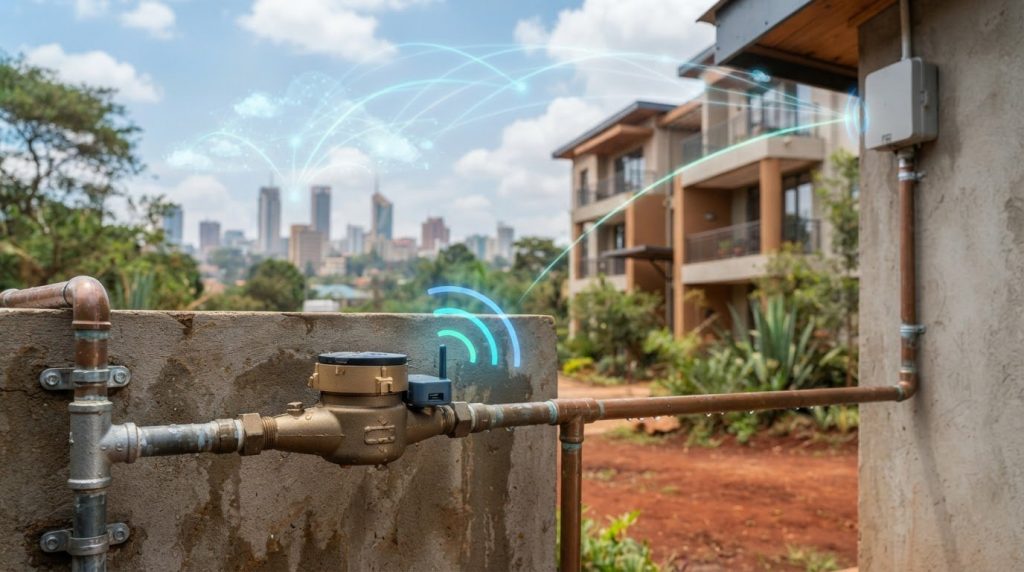
Water Meter with LoRa Connectivity: Benefits and Uses
Long-range, low-power communication makes LoRa a practical fit for smart water metering, especially where meters are spread across a site. A water meter with LoRa connectivity sends usage readings wirelessly to a gateway, which relays them to a central server or cloud platform. LoRaWAN devices can operate on small batteries for up to 16 years.
That combination can reduce manual meter reading and extend monitoring to remote or dispersed locations. It also supports more than recording consumption: usage data can inform billing, reveal patterns and flag unusual consumption that may point to a leak.
This guide explains how LoRa supports smart water metering, how two-way communication works and what low-power operation means for battery planning. It also covers residential and commercial uses, as well as the technology’s limits, to help you assess its role in a water-monitoring system in Kenya.
Key Takeaways
- Assess LoRaWAN’s long-range, low-power design against your network layout, data needs and tolerance for communication delays.
- Understand how two-way communication can support both meter reporting and network-side messages, subject to the system’s configuration.
- Plan battery expectations around transmission frequency and operating conditions; low-power design can extend service life, but does not set one lifespan for every meter.
- Match the metering setup to the use case, and consider smartmitaz’s Outdoor 4G-LoRa water meter gateway when connecting water-meter data to a wider network.
Why Choose LoRa Technology for Smart Water Metering?
LoRaWAN suits utility networks that need periodic readings from dispersed sites. Its long-range, low-power design can support monitoring where manual collection is difficult.
How LoRaWAN Water Meters Work
A LoRaWAN water meter measures flow and uses a radio module to transmit readings wirelessly. A gateway receives the transmission and relays the data through a network server to a monitoring platform. For a Nairobi property, map meter locations and building obstructions when planning gateway placement. This helps assess whether the network can reach meters across the site.
Private and Public Network Options
A private LoRaWAN network uses an organisation’s own gateways; a public network uses an operator’s infrastructure. Utilities can also combine both arrangements. Rural transmission can reach 15-30 kilometres, while urban reach is typically 2-5 kilometres. In Nairobi, frequency selection depends on compatible meter and gateway configurations, while the network choice depends on coverage and who manages the gateways.
Comparing Meter Connectivity Options
LoRaWAN is designed for long-range, low-power communication. NB-IoT and GSM use cellular networks, while manual meters rely on people to record readings. Automated collection can reduce the effort and resources needed for meter reading. However, LoRaWAN has lower data rates and higher latency than technologies designed for faster communication, so it is less suitable for real-time applications.
Accuracy, Standards, and Limitations
Measurement accuracy depends on the meter, not its LoRa connection. The International Telecommunication Union recognised LoRaWAN as a global standard in 2022; this does not establish a meter’s accuracy or Kenyan approval status. For Kenya, distinguish network compatibility from approvals relevant to the meter’s intended use. Configure a meter by placing it, setting network credentials, and connecting it to a gateway and server. Interference, coverage gaps, and latency can affect communication.
Bidirectional communication
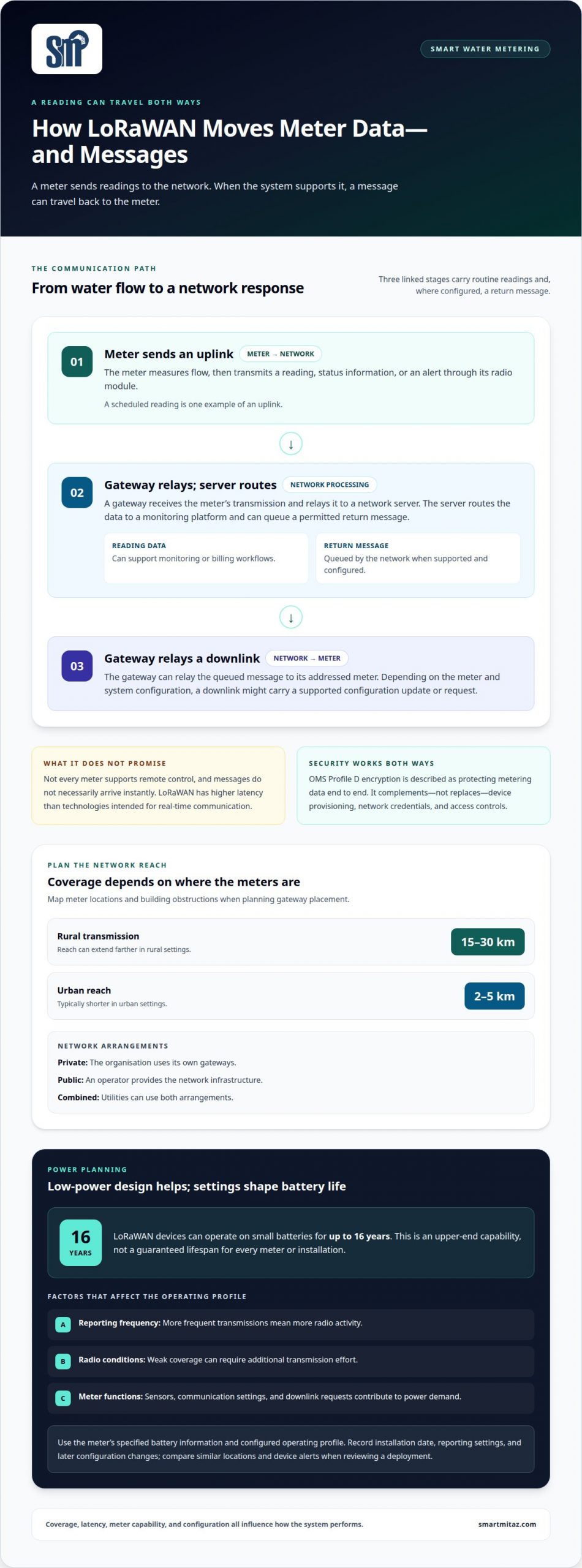
In a LoRaWAN metering system, communication can travel from the meter to the network and back. The meter’s uplink sends readings, status information or alerts to a gateway. A downlink carries a message from the network to the meter. This return path can support more than consumption-data collection, although available commands depend on the meter and system configuration.
Consider a residential meter that sends a scheduled reading. The network can receive the uplink, process it through a server and queue a downlink for the device. A downlink might carry a supported configuration update or request. This does not mean every meter can be controlled remotely or that messages arrive instantly. LoRaWAN’s low-power design also means higher latency than technologies intended for real-time communication.
- Uplink: The meter sends a reading or status message through a gateway.
- Network processing: The server routes the data and handles any permitted return message.
- Downlink: The gateway relays the queued message to the addressed meter.
For utility teams, this exchange can support remote device management alongside routine reading collection. A network operator can use downlinks for functions supported by the meter, while the server records readings for monitoring or billing workflows. Message timing and frequency matter: frequent exchanges can use more battery power, while delayed delivery may not suit urgent responses.
Security applies in both directions. OMS Profile D encryption is described as a way to protect metering data end to end. It complements the LoRaWAN network path but does not replace correct device provisioning, network credentials or access controls. Configure only the communication functions required for the metering task, then test that readings reach the server and authorized downlinks reach their intended devices.
Low-power operation and battery life
LoRaWAN is designed for low-power, wide-area communication, so connected devices can send small data messages while limiting radio activity. Devices using LoRaWAN can operate on small batteries for up to 16 years. Treat that as an upper-end capability, not a guaranteed lifespan for every water meter or installation. Meter settings, signal conditions, and operating demands affect actual battery life.
A meter typically measures flow and transmits readings at a configured interval. Between transmissions, its radio can remain inactive, reducing energy use. More frequent readings mean more radio activity. Downlink requests add activity too, so set the reporting schedule and remote functions to suit the monitoring task. Routine consumption records and frequent updates have different requirements.
- Reporting frequency: More frequent transmissions require more radio activity.
- Radio conditions: Weak coverage can require additional transmission effort.
- Meter functions: Sensors and communication settings contribute to total power demand.
For example, a meter in an underground chamber may face different radio conditions from one in an open installation. Placement and connection to the gateway can therefore affect the energy needed for communication. Battery capacity, measurement workload and reporting interval also shape the operating profile. Assess these factors together rather than relying on the protocol alone to predict service life.
For planning, use the meter’s specified battery information and configured operating profile. Record the installation date, reporting settings and any later configuration changes. These details help teams interpret battery status and plan replacements based on observed performance. In a large deployment, compare readings and device alerts across similar locations. Clear records make unusual battery drain easier to identify and investigate.
Within an Advanced Metering Infrastructure network, LoRaWAN offers a low-power, wide-area communication approach for connected meters. Battery planning should reflect the network’s purpose: communication needs to serve the monitoring task, rather than assume every device requires the same update pattern. LoRaWAN describes the network approach, while the configured operating profile and installation conditions remain important when assessing a meter’s likely service life.
Smart water metering applications
LoRa-connected meters can serve residential properties, commercial facilities, underground networks and remote infrastructure. A water meter with LoRa connectivity measures flow and uses a radio module to send readings wirelessly. In a residential block, readings can support unit-level consumption records; at a commercial facility, managers can compare use across operating areas. Remote sites can transmit readings without routine visits to each meter.
Billing is one practical application. Smart-meter readings can support charges based on actual water use rather than estimates. A property manager can review consumption by meter and billing period, giving teams a clearer basis for investigating changes. The value of readings from a water meter with LoRa connectivity depends on how the property organizes and uses the data.
- Usage monitoring: Compare readings over time to understand consumption patterns.
- Leak investigation: Look for unusual readings, then inspect the relevant meter and location.
- Supply planning: Use site-level consumption data to inform water-supply decisions.
For example, a facilities team monitoring several buildings can compare readings and identify a change in one building. Continuous monitoring can flag unusual patterns early, but a reading signals the need to investigate, not proof of a leak. Checking the affected meter and site conditions helps distinguish a leak from a genuine change in use.
Choose the application before setting reporting needs. Billing prioritises dependable consumption records; leak monitoring depends on noticing meaningful changes; supply planning benefits from patterns across locations. These purposes guide how teams interpret readings and organise follow-up. For a connected metering setup, explore a smart water-meter gateway as part of the network.
These devices are generally battery-operated and used in residential installations, commercial facilities, underground networks and remote infrastructure. They bring water metering to occupied properties as well as locations where infrastructure is less accessible.
LoRa-based water-use data can also inform water-supply planning, alongside billing, usage-pattern monitoring and leak detection. Continuous monitoring can help flag leaks or unusual patterns early. The same readings can document consumption and inform supply decisions, while unusual patterns can prompt timely investigation.
Smartmitaz: Outdoor 4G-LoRa water meter gateway
smartmitaz’s Outdoor 4G-LoRa water meter gateway is a hardware option for connecting LoRa water-meter readings with a 4G network path. Consider it when a metering setup needs a gateway to relay data from connected meters toward a monitoring system. The right network design depends on the meters, coverage, and data route required at the site.
Use a gateway as part of a broader smart-metering setup, not as a substitute for the water meter. For residential applications, smartmitaz also offers the Residential Smart Prepayment Water Meter. Choose products according to their roles: measuring water at the meter or communicating data through the gateway.
Contact smartmitaz or visit smartmitaz.com to discuss the gateway for your metering setup.
Plan Your Next Metering Upgrade
Choose a water meter with LoRa connectivity by first defining the operational outcome you need. Decide which locations require readings, how your team will use the data and how the network will connect meters to a monitoring platform. This turns a broad technology choice into a practical system-planning decision.
Match each device to its role. smartmitaz offers an Outdoor 4G-LoRa water meter gateway, alongside Single Phase Smart Prepayment Meter and Three Phase Smart Prepayment Meter options. These products support different parts of a metering setup, so identify the required equipment before planning an upgrade.
A clear requirements list can help frame the next discussion: meter type, site layout, data needs, and preferred network arrangement. Use it to assess how LoRa-based metering fits your property or utility monitoring plans. Contact smartmitaz about LoRa metering to discuss the relevant products for your setup. Take the next step with a defined plan and a clearer view of your metering needs.
Frequently Asked Questions
What is the range and battery life of LoRa water meters?
LoRaWAN transmission can reach 15-30 kilometres in rural areas and 2-5 kilometres in urban environments; devices using it can operate on small batteries for up to 16 years. Actual performance depends on gateway placement, obstructions, signal conditions, and how often the meter transmits. For a Nairobi property, building layout and meter location affect the practical coverage assessment.
What software or gateway is needed to monitor LoRa water meter readings?
A monitoring setup generally needs a gateway, a LoRaWAN network server, and a platform to display or process readings. The gateway receives meter messages and relays them onward to the server or cloud platform. smartmitaz offers an Outdoor 4G-LoRa water meter gateway. Select the monitoring software and gateway arrangement to suit the network design and the way your team uses readings.
[…] the equipment your property needs, rather than assuming the gateway replaces the meter. Learn how a water meter with LoRa connectivity sends readings to a gateway and supports remote […]