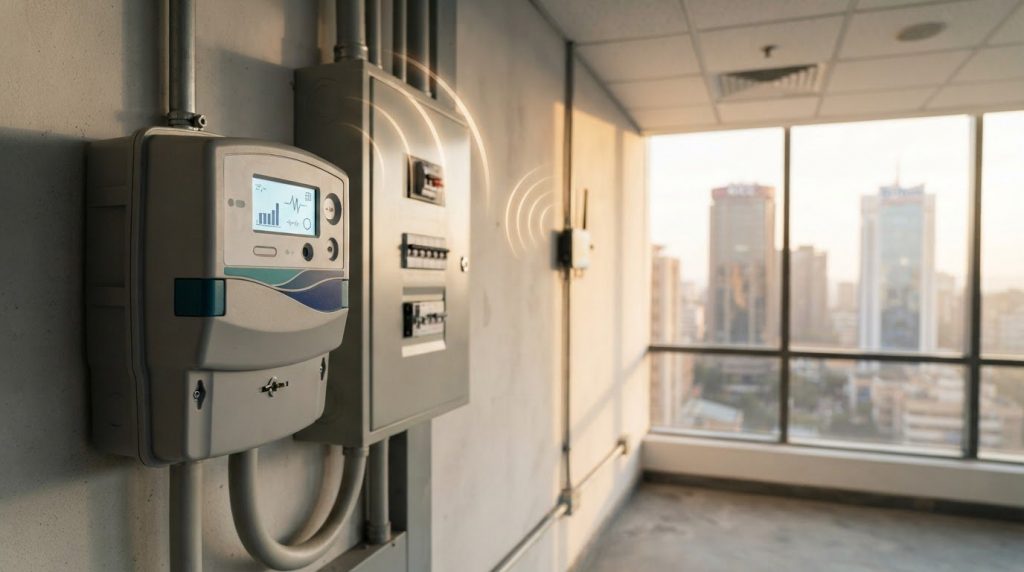
Commercial Smart Electricity Meters: Accuracy and Remote Reads
A commercial smart electricity meter measures and records electricity use, then sends readings remotely over a wireless connection. It can capture usage in 15-minute intervals, giving businesses a clearer view of when power is consumed. Remote reporting removes the need to rely on manual readings, but accurate data still depends on the meter’s measurement performance.
For a commercial property, that distinction matters. Meter readings can show consumption patterns and help identify unusual use, but a smart meter does not reduce electricity consumption on its own. Its value lies in the data it provides for monitoring and informed energy decisions.
This article explains what smart meters measure, how they transmit and report readings, and what to consider about accuracy in three-phase applications. You’ll also learn how these meters relate to commercial premises in Kenya, including Nairobi, where three-phase systems may suit businesses with heavier electrical loads. The aim is practical: understand measurement, communication and accuracy before choosing a meter for a site.
Key Takeaways
- Separate measurement accuracy from remote-read convenience: communication makes readings available remotely, while the meter’s accuracy depends on its measurement performance and applicable standards.
- Use IEC 62053 and MID as reference points when assessing meter accuracy and certification, and understand what each standard covers before comparing specifications.
- Look at how readings are stored and transmitted to understand the reporting process, including the role of two-way communication between a meter and a control centre.
- Match the meter configuration to the premises’ electrical system and load; three-phase meters serve commercial and industrial applications with heavier equipment.
- Choose a water-meter gateway for remote water metering, not as a substitute for an electricity meter.
What Is A Smart Meter?
A commercial smart electricity meter measures and records electricity consumption, then sends readings remotely over a wireless connection. Sensors measure voltage and current, and the meter processes those values into energy-use data. Businesses can use the information to track consumption across a site and spot periods when demand rises.
Some meters store readings at 15-minute intervals and upload them together; others transmit data at each interval. The meter’s display can show current energy use and cost. This makes it easier to compare operating periods, such as a busy shift against an idle period, and spot equipment that continues drawing power.
What are the requirements to install a commercial smart meter in Kenya? The meter must match the site’s electrical supply, phase configuration, expected load and metering arrangement. If installation involves the utility’s metering system, coordinate with the relevant electricity provider.
How much does a commercial smart meter cost in Kenya? Cost depends on the meter configuration, current rating, communication method and any compatible metering equipment required. Compare the full specification and necessary components rather than the meter category alone.
Which Kenyan electricity providers offer commercial smart meters? Kenya Power’s planned procurement includes 19,103 smart meters for commercial and industrial customers, including 18,000 three-phase smart meters. This identifies Kenya Power’s procurement, rather than establishing which other providers offer them.
What data privacy and cybersecurity risks apply to commercial smart meters? Remote readings can reveal operating patterns, while weak access controls or insecure communications may expose data or enable unauthorised commands. Restrict account access, use secure network settings and review who can retrieve or act on meter data.
Standards help businesses assess measurement and energy-management claims. IEC 62053 is a reference for electricity meter performance, while the Measuring Instruments Directive (MID) is another conformity reference. These are not interchangeable with Kenyan installation requirements. ISO 50001 supports energy management by helping an organisation structure its monitoring and improvement work.
Match the meter to the premises. A single-phase system generally suits lower-power settings, while three-phase meters serve commercial and industrial premises with heavier loads and appliances. The site’s supply and equipment determine the suitable configuration, not its business label alone.
Use interval data to build a consumption profile before discussing energy tariffs or supply arrangements. Compare operating hours, peak-demand periods and idle loads across similar days. The evidence can inform a practical discussion, but the meter provides data, not a guaranteed discount. Smart metering does not cut consumption on its own; businesses need to act on the patterns it reveals.
Meter accuracy and certification standards
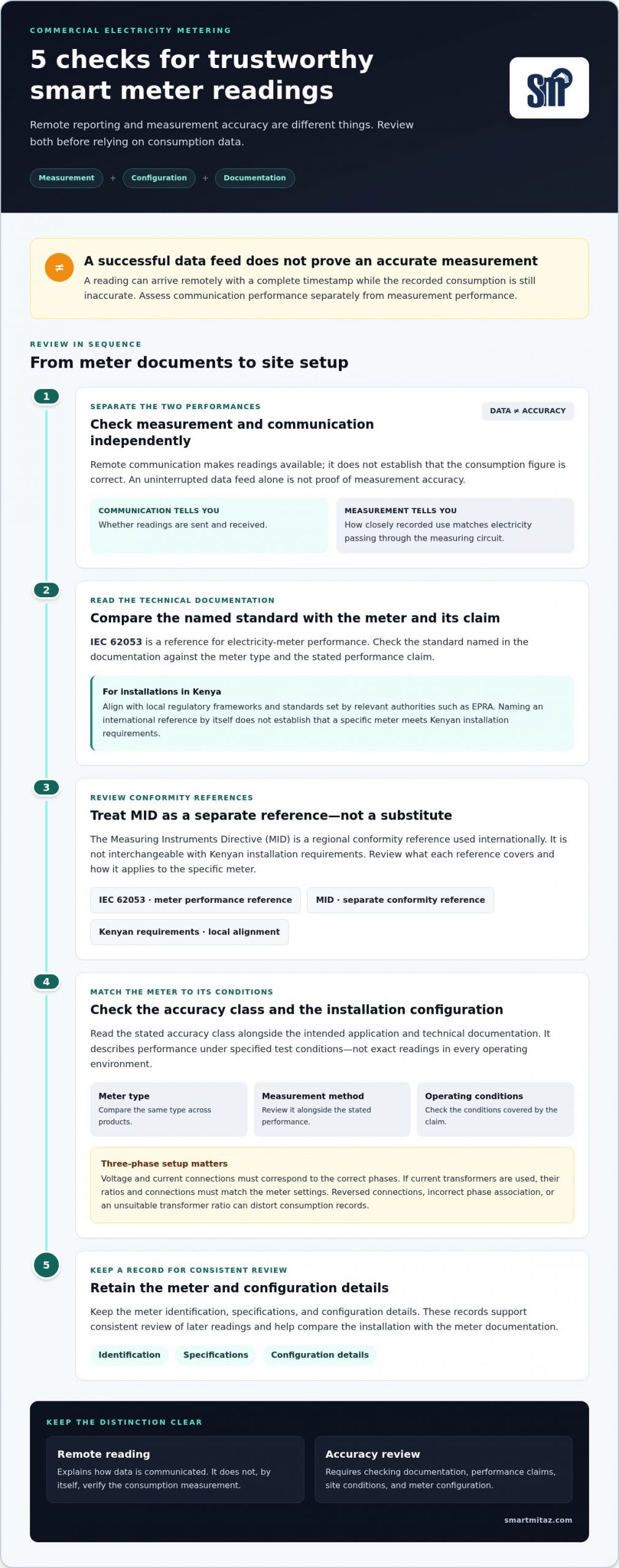
Accuracy describes how closely recorded energy use matches the electricity passing through a meter’s measuring circuit. A remote reading can arrive correctly even if the measurement is inaccurate. For a commercial smart electricity meter, assess measurement performance separately from communication performance. A complete timestamp or uninterrupted data feed does not, by itself, prove the consumption figure is accurate.
IEC 62053 is a reference for electricity-meter performance. Compare the standard named in the documentation with the meter type and stated performance claim. While regional frameworks like the European Measuring Instruments Directive (MID) exist internationally, commercial installations in Kenya must primarily align with local regulatory frameworks and standards set by relevant authorities such as the Energy and Petroleum Regulatory Authority (EPRA). These references support a technical review, but naming them alone doesn’t establish that a specific meter meets requirements for a Kenyan installation.
Read the stated accuracy class alongside the meter’s intended application and technical documentation. The class describes performance under specified test conditions, not exact readings in every operating environment. Compare the same details across products, including meter type, measurement method and operating conditions. Do not infer accuracy or certification from wireless functions or a product image.
Configuration also matters. In a three-phase installation, voltage and current connections must correspond to the correct phases. If current transformers are used, their ratios and connections must match the meter settings. A reversed connection, incorrect phase association or unsuitable transformer ratio can distort consumption records, even when a commercial smart electricity meter is designed to meet IEC 62053.
- Match the standard: Compare the IEC 62053 reference in the documentation with the meter type and performance claim.
- Review conformity evidence: Treat regional or international directives as separate references, aligning them with local Kenyan requirements.
- Check configuration: Compare phase connections, transformer details and meter settings with the site’s electrical arrangement.
- Keep records: Retain identification, specifications and configuration details for consistent review of later readings.
ISO 50001 addresses energy management, not meter accuracy. Businesses can use its framework to organise consumption monitoring, review energy performance and document improvement actions. Accurate readings support this work, but an energy-management standard cannot correct a wiring or configuration error.
Review the technical sheet, conformity information and site configuration together. For a three-phase site, compare the requirements with three-phase meter options and the applicable accuracy references before deciding what fits.
Professional codes of practice, such as the UK’s Ofgem-approved Smart Metering Installation Code of Practice (SMICoP), offer useful operational benchmarks, though local Kenyan installation guidelines take precedence for domestic projects. These frameworks complement checks of meter performance and site configuration rather than replacing them. Smart meters can also reveal electricity used by equipment during idle periods and standby loads that might otherwise go unnoticed. These insights can support a closer review of consumption, alongside accurate measurement.
Smart meter measurement and remote communication
A smart meter converts electrical measurements into time-stamped consumption records. Sensors measure voltage and current, and the meter processes those inputs into energy-use data. A commercial smart electricity meter has two distinct tasks: capturing consumption and communicating the resulting records to a receiving system.
Recording frequency determines the detail available. A meter can store readings at 15-minute intervals and upload them together. Another configuration may transmit data at each interval. This level of detail can help a facilities team compare a working shift with quieter hours and identify when site demand changes.
Wireless communication sends readings to a utility or monitoring system. Some meters transmit readings by radio many times per hour. Two-way communication can also carry information back to the meter. For example, depending on its functions, a control centre may remotely update tariff tables or meter settings.
Remote access changes the reading process. Rather than relying only on a site visit, a control centre can retrieve records electronically. A property team can compare consumption with the building’s operating schedule and investigate any mismatch. The data can point to a pattern, but staff may need to inspect equipment to find its cause.
Communication quality affects when data arrives, not whether the meter measured correctly. A transmission gap can interrupt the monitoring view even if readings were stored locally. Review timestamps and continuity before comparing periods. In a 15-minute series, a missing interval can obscure a short demand change.
- Check interval detail: Establish whether readings are stored or transmitted at each 15-minute interval.
- Review the data path: Identify the receiving system and how it retrieves meter records.
- Compare consistent periods: Use matching operating hours when reviewing energy consumption.
- Separate data from action: Use readings to investigate changes, then decide what may support energy saving.
Some smart meters can also send supply-failure information to a provider. Certain models can receive radio commands to switch power on or off. These functions depend on the meter’s capabilities and configuration. Do not assume every commercial smart electricity meter has them simply because it supports remote readings.
5G is identified as a future connectivity trend for commercial meters. For a business choosing a commercial smart electricity meter, the practical priority is matching communication needs to the site and receiving system. Meter data can support operational decisions, but savings depend on how the business responds to consumption patterns.
Smart electricity meters can measure and communicate consumption data to utility providers remotely, removing the need for manual readings. They can also support two-way communication between the utility and the consumer.
Smart-meter remote reading and reporting
A traditional electricity meter was typically read once a month, with the previous reading subtracted from the current one to calculate consumption for the period. This gives a total, but not a detailed view of changes within the month. Remote meter reading provides usage data without someone visiting the meter. For a commercial site, this can simplify routine reporting across different operating periods.
Remote reporting connects the meter to a control centre or receiving system. The system can retrieve readings and present them for billing or energy monitoring. Smart meters may also support remote tariff-table updates and meter configuration. These functions affect how readings are managed, not the underlying measurement. Reports should state the period each reading covers and whether it is a total or interval data.
Interval records give companies more context than a single monthly figure. Managers can compare daytime consumption with overnight use and relate changes to operating schedules. A series of readings may reveal a rise during a shutdown or a drop after equipment schedules change. The meter provides evidence for investigation; staff still need to identify the equipment or process behind the pattern.
Useful reporting depends on consistent, complete records. Compare readings over matching periods and check timestamps before drawing conclusions. If a report has a gap, do not treat the missing interval as zero consumption. Note the gap, compare the next available reading and distinguish incomplete reporting from a genuine change in energy use.
- Review the reporting period: Confirm whether the report shows a monthly total or interval records.
- Compare like periods: Align operating hours and dates before assessing consumption changes.
- Track adjustments: Record tariff-table updates or meter configuration changes alongside reporting records.
An existing advanced meter that already sends readings remotely to an energy company may not need replacing. Focus on the functions available, not the label alone. Compare the current meter’s reporting capabilities with the business’s needs for remote access, usage detail and configuration. This helps avoid treating replacement as the default when remote readings already meet the site’s reporting needs.
For a commercial electricity account, remote readings can support billing based on recorded use rather than estimates. They also give property teams a regular view of consumption without manual collection. Use reports to investigate changes and document operational decisions. A meter can provide timely readings, but any energy savings depend on what the business does after reviewing them.
Three-phase meters for commercial and industrial premises
Three-phase meters suit commercial and industrial premises with high power consumption and heavy appliances. They record energy use across a three-phase supply, showing businesses the site’s combined demand. This configuration may be relevant when equipment such as large motors or commercial machinery draws substantial power. Single-phase meters are generally associated with lower power requirements, so phase configuration matters when matching a meter to a premises.
Consider the site’s electrical arrangement and the loads it serves. A workshop running heavy machinery, for example, needs metering suited to its three-phase supply. The meter must represent the supply being measured; choosing by business size alone can overlook important differences between premises. Review the equipment, expected demand and existing metering setup together before selecting a configuration.
Kenya Power’s planned procurement includes 19,103 smart meters for commercial and industrial customers, including 18,000 three-phase smart meters. These figures show the relevance of three-phase metering in Kenya’s business sector. They describe planned procurement, not a count of meters already installed or a requirement for every commercial premises.
Some large electrical loads use current transformers and potential transformers, together known as CT-PT metering. CT-PT meters are used in high-voltage applications to measure large electrical loads. The transformers provide measurement inputs, allowing the meter to represent a load that is not measured through a direct connection alone. This differs from choosing a meter solely by phase count: voltage and load characteristics matter too.
Use these distinctions to assess a site’s metering needs:
- Supply configuration: Identify whether the premises uses single-phase or three-phase power.
- Load profile: Consider heavy appliances and machinery that shape the site’s energy usage.
- Measurement arrangement: Determine whether the application involves direct metering or CT-PT measurement.
- Monitoring purpose: Decide whether the business needs a combined premises reading or information for a specific operational area.
When comparing meters, assess phase suitability separately from communication and prepayment functions. A three-phase configuration addresses the electrical supply; remote reporting and payment functions meet different operating needs. Keep these requirements distinct when reviewing specifications. This makes it easier to compare like-for-like options and identify a suitable meter for a commercial or industrial site.
Review three-phase meter options against your premises’ supply configuration and load requirements.
Smartmitaz: Outdoor 4G-LoRa water meter gateway
smartmitaz offers an Outdoor 4G-LoRa water meter gateway for remote water-meter monitoring. It addresses a different measurement need from a three-phase electricity meter: use it for water-meter data, not electrical consumption. For commercial premises reviewing electricity metering, smartmitaz also offers a Three Phase Smart Prepayment Meter. Its three-phase configuration is relevant when the site uses a three-phase electrical supply and needs a matching prepayment meter. Keep these roles separate when planning site monitoring: the gateway supports water-meter communication, while the electricity meter measures electricity. Choose according to the utility being measured and the premises’ supply configuration. Contact smartmitaz to discuss its metering products.
Set Up Your Next Metering Decision
Turn meter data into a practical operating plan. Start by identifying what the premises needs to measure, how readings should reach the monitoring system and which electrical configuration suits the site. A commercial smart electricity meter should meet those requirements without adding features that do not serve your energy-management priorities. Keep electricity and water monitoring distinct when planning equipment across a property.
smartmitaz offers a Three Phase Smart Prepayment Meter for three-phase electricity applications and a Single Phase Smart Prepayment Meter for single-phase setups. For water monitoring, its Outdoor 4G-LoRa water meter gateway serves a separate purpose. Align the product category with the utility and supply configuration you need to manage.
Use those requirements to guide your next product discussion. Contact smartmitaz about smart meters and take the next step toward a metering setup that fits your premises.
Frequently Asked Questions
What Is a Commercial Electricity Meter?
A commercial electricity meter records the electrical energy supplied to business premises for consumption accounting. It helps the account holder track use at that premises, rather than measuring water or another utility. A workshop, for example, can compare electricity consumption across billing periods and relate changes to operating hours or equipment use. The meter’s configuration must suit the site’s electrical supply.
What is a commercial smart electricity meter and how does it work?
A commercial smart electricity meter combines consumption measurement with electronic data handling and remote communication. In a prepayment setup, a business pays in advance and can use meter records to follow consumption and manage credit. Smart prepaid meters can also support remote reading and tamper detection. A property manager, for example, can review recorded activity when reconciling a site’s utility account, while keeping water-meter equipment separate from electricity metering.
How does a commercial smart meter compare with a conventional electricity meter?
A conventional electricity meter is generally read manually and does not provide the same two-way communication as a smart meter. A smart model can send readings remotely, reducing the need for someone to visit the meter. For a business with several premises, remote access can make routine readings easier to manage. Its value depends on whether the business uses the additional data and communication functions.
How can businesses monitor usage and manage bills with a smart meter?
Businesses can compare meter records with account statements and operating schedules to investigate consumption changes. A manager, for example, can note an increase during a billing period, compare the relevant readings and review equipment use during that time. Keep meter readings and records of operational changes together. This helps distinguish a billing-period difference from a change in site activity, without assuming the meter itself will cut costs.
What should a business check before buying or installing a commercial smart meter in Kenya?
Check the premises’ phase configuration, expected electrical demand and whether the metering arrangement requires current transformers. Review the meter’s technical and accuracy documentation, along with its communication and prepayment functions. For a Nairobi business, confirm that the proposed meter matches the account’s metering arrangement and coordinate relevant requirements with the electricity provider. A three-phase supply needs a meter configuration suited to it.