
Smart meters for apartments,landlord,commercial,malls,hotels,hostels
The right prepaid electricity metering hardware depends on the property as much as the payment method. A prepaid meter measures electricity use and deducts it from a balance, which is credited in kilowatt-hours when a user enters a token PIN. When the balance reaches zero, the meter automatically turns off the power supply.
For an apartment, rental property, mall, hotel or hostel, the choice involves more than selecting a meter. Integrated and split designs place the keypad differently, while single-phase and three-phase meters suit different electrical supplies. Those choices affect where users access the keypad and how the equipment fits the site.
This guide explains how prepaid meters work and compares the hardware formats used for residential and commercial properties. It also covers low-credit alerts, remote management, billing and energy use, so you can understand what the system can do and which features matter for your property. Use the distinctions to assess your metering needs and plan a practical approach to managing electricity credit and consumption.
Key Takeaways
- When a prepaid meter’s balance reaches zero, it automatically turns off the power supply; low-credit alerts can help users plan a recharge before then.
- Remote communication can support credit updates, meter readings, and disconnection or reconnection without relying on manual access to the meter.
- Match the meter type to the property’s electrical supply and layout, including whether a single-phase or three-phase meter and an integrated or split keypad design is appropriate.
- Prepaid metering records and bills usage against available credit, but it doesn’t lower the electricity rate by itself.
- Use consumption information to identify usage patterns and make more informed decisions about energy use in apartments and commercial properties.
Low-credit alerts and automatic disconnection
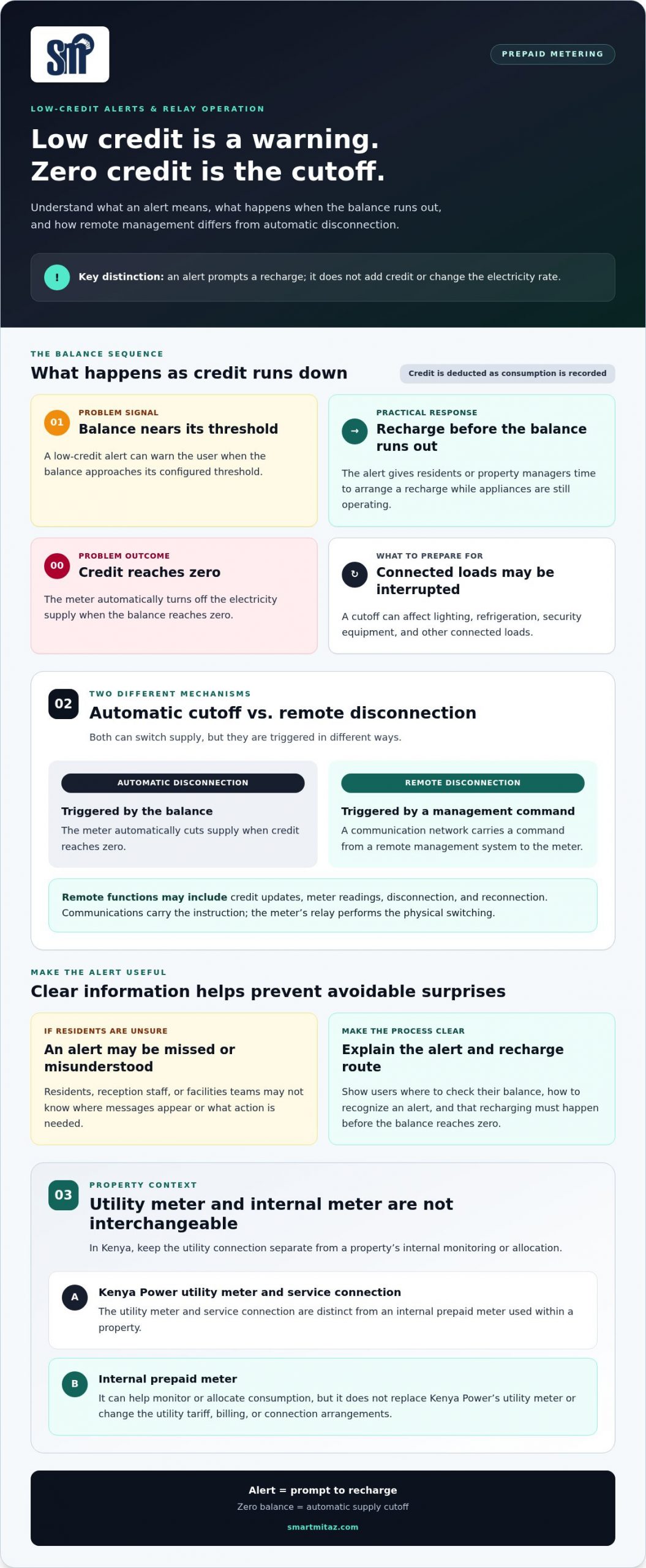
A prepaid meter tracks remaining credit as electricity is consumed. Alerts give residents or property managers time to arrange a recharge before supply stops.
In Kenya, distinguish Kenya Power’s utility meter and service connection from an internal prepaid meter used to monitor or allocate consumption within a property. An internal meter does not change Kenya Power’s tariff, utility billing or connection arrangements.
Low-Credit Alerts and Relay Operation
A low-credit alert can warn a user that the balance is nearing its configured threshold, while a meter relay controls the electricity supply. This matters in an apartment or hostel because residents can arrange a recharge before the balance runs out.
For example, a tenant may receive an alert while appliances are still operating and recharge before the available balance runs out. The prepaid meter deducts credit as consumption is recorded. An alert is a prompt, not additional credit or a change to the electricity rate.
The relay is the switching component inside the metering arrangement. When the balance reaches zero, the meter automatically turns off the supply. That protects the prepaid arrangement from continued use without credit, but it can interrupt lighting, refrigeration, security equipment, or other connected loads.
Property managers can make alerts useful by ensuring residents know where messages appear and how to respond. A notice in a shared meter room, for instance, can explain that an alert signals low credit and that recharging must happen before the balance reaches zero. Keep the process clear for tenants, reception staff, and facilities teams.
Remote Disconnection and Consumer Protection
Remote disconnection uses a communication network to send a command to a meter, while automatic disconnection occurs when the balance reaches zero. The distinction matters because a remote command is sent through a management system, whereas zero-credit disconnection follows the meter’s balance.
Smart prepaid meters may support remote credit updates, meter readings, disconnection, and reconnection. In a commercial building, remote management can reduce the need to access a meter room for each account action. The meter’s relay still performs the physical switching; communications carry the instruction.
Consumer protection starts with clear information, accurate credit display, and a usable recharge route. For a hostel, explain how residents can view their remaining balance, recognize an alert, and restore credit. A remote command should be traceable to the relevant meter and account, particularly where several units share one property infrastructure.
Separate utility supply from internal allocation. A landlord’s prepaid submeter can help track a tenant’s consumption, but it does not replace Kenya Power’s utility meter or alter the utility’s billing relationship. This distinction helps prevent confusion if a unit’s meter stops supply while the building’s main supply remains active.
Smart meter communications and remote management
Communication networks let smart prepaid meters exchange information with a remote management system. This can support credit updates, meter readings, disconnection, and reconnection.
In Kenya, distinguish a Kenya Power meter from an internal property meter. A property’s smart meter does not automatically connect to Kenya Power’s vending or billing systems. Its communication and account arrangements depend on the metering system in use.
Meter installation or replacement depends on which equipment is involved. Kenya Power manages its utility metering equipment, while an internal meter serves a property’s monitoring or allocation needs. An internal meter does not replace the utility meter or change the utility account.
There isn’t one cost figure that applies to every prepaid meter and installation in Kenya. The total depends on the meter type, the electrical supply, site layout, communication requirements, and the work needed to fit the system.
If a token is rejected or an error appears, confirm that the token belongs to that meter and enter its digits carefully. Check the display for an error message and follow the meter’s operating instructions. A token for a different meter cannot add credit to the intended one.
Prepaid Balance Management and Recharge
A remote credit update sends purchased credit to a compatible smart prepaid meter through its communication network. Token-based systems instead require the user to enter a PIN at the meter. smartmitaz also offers token vending and automatic recharge via M-PESA Mobile Money.
For a landlord managing separate units, each meter’s account and balance should map clearly to the correct apartment. Accurate mapping helps avoid assigning a recharge or reading to another resident’s meter. The meter and management system must support the communication method in use.
Remote Top-Ups and Meter Management
Remote management can bring meter readings and account actions into a central workflow. A property manager can review readings for several units and identify which account needs attention without visiting each meter location.
Remote functions depend on communication between the meter and its management system. Network coverage, compatible equipment and correct meter identification all affect whether information reaches the intended device. Remote access changes how data or commands travel, not how the meter measures consumption.
Household Electricity Management
For a household, a recorded balance and consumption history can help residents relate electricity use to available credit. Reviewing the meter after using high-demand appliances, such as an electric cooker, can help explain changes in the remaining balance.
At a hostel or commercial site, remote readings can support account monitoring across separate spaces. Keep unit records distinct and make recharge instructions clear to residents or staff. Remote management supports oversight, but it does not itself change electricity rates or guarantee lower consumption.
What Is a Prepaid Meter?
A prepaid meter records electricity use and deducts its cost from available credit. The user adds credit before consumption, linking recorded electricity usage with the balance. A token-based device may add credit when someone enters its PIN.
In a Nairobi apartment, a separate internal meter can help allocate electricity use to an individual unit. The resident’s meter reading then reflects that unit’s recorded consumption rather than the combined use of every apartment. Clear meter identification helps landlords match readings and balances to the right tenant.
Rental properties can use individual meters to make electricity allocation clearer to tenants. For example, a landlord managing several flats can review each unit’s reading separately instead of relying only on a building-wide total. The meter records use, while property managers maintain clear account and recharge procedures.
In a school, prepaid metering can support monitoring for areas such as staff housing, workshops or a separate kitchen. A reading assigned to one area helps administrators compare its electricity use with other monitored spaces, providing a practical basis for reviewing consumption patterns.
Commercial buildings have different monitoring needs from homes. A shop, hotel or office may need separate readings for tenant units, guest facilities or shared services. Choose a metering arrangement based on the areas that need their own usage records and who needs access to the information.
Commercial electricity monitoring helps show where consumption occurs. For example, a property manager can compare readings from a retail unit and a shared corridor over the same period. The readings show recorded use, but do not explain on their own why consumption changed.
Use meter readings alongside operational context. A hotel may record higher use when more rooms are occupied, while a school workshop may use more electricity during practical sessions. Comparing readings with activity helps managers interpret the data instead of treating every change as a fault or waste.
A prepaid meter differs from a conventional billing arrangement in how payment relates to use. Credit is available for consumption, and the meter deducts the corresponding cost as electricity is recorded. The meter does not set or lower the electricity rate.
For a multi-unit property, define the monitoring boundary before choosing a device. Decide whether the goal is to record one home, a tenant’s unit or a commercial area. That boundary determines which readings are useful and how records support energy management.
Prepaid metering can be relevant across homes, rentals, schools and commercial buildings. A useful reading links a specific meter to a clearly identified space, giving residents or managers a practical record of electricity use.
Billing accuracy and energy conservation
An accurate energy meter records electricity use so billing or internal cost allocation reflects measured consumption. A prepaid meter deducts the cost from available credit, but it doesn’t set or reduce the electricity rate. In a Nairobi rental, the meter reading and the applicable rate are separate parts of the calculation.
For a clear billing record, match each reading to the correct meter and property area. A landlord managing apartments can label each device by unit, then compare its recorded use with the tenant account. This recordkeeping helps distinguish an incorrect meter assignment from a change in consumption.
Meter suitability depends on whether the device matches the electrical supply and circuit being monitored. A mismatch can make readings unsuitable for their intended use. For a commercial space, select a meter for the circuit it measures, not simply because it fits inside the panel.
Tamper detection addresses a different concern from measurement accuracy. Smart prepaid meters can support tamper detection, while controlled access to a meter can make physical changes easier to notice. Property managers should record meter identifiers and readings during handovers, such as when one tenant leaves and another moves in.
Those records also help investigate billing differences. Compare readings at the start and end of a billing period, confirm they belong to the same device, and check that the account uses the correct rate. For a hotel, separate records for guest areas and staff facilities can clarify where use is recorded.
DIN rail mounting describes how a meter attaches inside an electrical panel. It can support an organized installation, but the mounting format alone does not establish that readings are accurate. A DIN Rail Single Phase Smart Prepayment Meter still needs to suit the supply and circuit it measures.
Energy conservation comes from decisions informed by consumption data, not from a meter changing the rate. A school can compare readings for a workshop and office area, then review operating schedules or equipment use where consumption differs. The meter provides evidence for that review; managers decide what changes to make.
For a commercial property, build meter readings into routine energy management. Compare similar operating periods, note changes in occupancy or equipment use, and investigate unexpected increases. A mobile record or spreadsheet can help staff organize readings, provided the figures match the correct meter and period.
Automatic credit deduction makes the balance reflect recorded electricity use, while billing accuracy depends on correct readings, rate application and account matching. Treat these as separate checks. A meter records consumption but does not explain why it changed, so consider context such as operating hours or occupancy.
Use a consistent handover record for each property: meter identifier, date, opening reading, closing reading and responsible account. In an apartment block, this creates a clear basis for comparing use between tenant periods and reviewing billing questions without confusing one unit’s consumption with another’s.
Prepaid electricity meter product types
A prepaid electricity metering system combines a meter with a way to enter or transmit credit. Some systems use a token PIN entered manually; smart models may support remote credit updates through communication networks. Choose prepaid electricity metering hardware by considering the electrical supply, meter location, keypad access, and how credit will reach the device.
For a Kenya Power connection, the utility’s metering process governs its revenue meter. A property-level meter can record internal electricity distribution, but it does not replace Kenya Power’s meter or automatically become part of its billing system. This distinction helps landlords separate utility supply from tenant allocation.
There is no single model name that answers which meters suit every use. The relevant distinction is whether the device is a Kenya Power revenue meter or an internal property meter. Internal meters serve the property’s own monitoring or allocation arrangement.
Choose a Keypad Format
An integrated prepaid meter has its keypad built into the meter unit. It suits a layout where the meter sits beside or below the distribution board, allowing residents to enter a token PIN at the device.
A split meter places the keypad separately from the meter itself. This arrangement can suit a lockable meter box or room where residents need keypad access outside the secured meter location. For example, an apartment manager can keep the meter protected while providing users with a separate place to enter credit.
Split designs can use wired or wireless communication between components. The practical choice depends on the distance between components, the equipment and installation costs. Consider the route between the meter and keypad, especially when a meter room is away from a tenant’s unit.
Match the Meter to Supply and Site
Single-phase and three-phase meters serve different electrical supply arrangements. Check the property’s supply and distribution layout before choosing a type. A home or apartment may have different requirements from a mall or hotel with commercial loads and shared areas.
The right prepaid electricity metering hardware also depends on the credit method. A token-based unit needs a keypad for PIN entry; a remotely managed system needs compatible communication between the meter and management setup. The meter’s switching function controls supply when its balance reaches zero.
For a school, hostel or rental block, define what each meter should measure: an individual room, tenant unit or shared facility. That decision guides meter placement, user access and reading records. Keep each device matched to its assigned area.
Before purchase, map the property’s supply type, distribution board, meter location, and user access needs. Explore prepaid metering options for residential and commercial applications.
Smartmitaz: Outdoor 4G-LoRa water meter gateway
smartmitaz offers an Outdoor 4G-LoRa water meter gateway for projects involving water meter communications, alongside smart prepayment meters for electricity and water. Consider the gateway when a property needs a connection point for water metering equipment; choose electricity meter types based on the property’s supply and monitoring needs.
For electricity, the Single Phase Smart Prepayment Meter is designed for single-phase applications, while the Three Phase Smart Prepayment Meter is intended for three-phase applications. For residential water metering, the Residential Smart Prepayment Water Meter is a relevant option. Match the equipment to the utility being measured.
Smart Mitaz offers smart prepaid electricity meters, water meters and a water meter gateway. Explore the available metering options on smartmitaz.com to find hardware suited to your property’s monitoring needs.
Set Up Your Next Metering Decision
Before choosing prepaid electricity metering hardware, define what your property needs: clearer tenant allocation, readings for a specific area or a practical way to manage separate accounts. Then map each meter to its supply type, location and users. This gives you a clear basis for comparing hardware across apartments, hotels, hostels and commercial buildings.
For single-phase and three-phase electricity applications, smartmitaz offers the Single Phase Smart Prepayment Meter and Three Phase Smart Prepayment Meter. Its range also includes an Outdoor 4G-LoRa water meter gateway for water-meter communication. These are hardware options, not electricity or water utility services.
Use your property requirements to guide the next conversation, including which areas need separate metering and how users will access their credit information. Contact smartmitaz about meter hardware to discuss the options relevant to your project. A defined metering plan makes the next step more focused and easier to manage.
Frequently Asked Questions
How do prepaid electricity meters work, including token vending and keypad units?
A prepaid meter deducts electricity costs from credit added to the meter. With token vending, the user receives a code and enters its PIN on the keypad; the credit is then added to that meter. In a shared Nairobi apartment building, each tenant must use the token assigned to their own meter. Integrated keypads sit on the meter, while split designs place the keypad separately for easier access.
How do single-phase and three-phase prepaid meter hardware options compare?
Choose the meter type to match the property’s electrical supply: single-phase or three-phase. A distribution board can offer a visual clue: one or two joined circuit breakers at the main switch indicate single-phase supply, while three or four joined breakers indicate three-phase supply. For example, a landlord planning meters for different buildings should identify each building’s supply before selecting hardware, rather than assuming one meter type suits every site.
What safety, compatibility, and tampering risks should buyers check?
Check that the meter suits the electrical supply and circuit it will measure, then ensure its location allows secure access for users and authorized personnel. A mismatch can make readings unsuitable for the intended account. For example, keep a meter assigned to one shop clearly identified in property records. Smart prepaid meters can support tamper detection, and access controls can help managers monitor physical access.