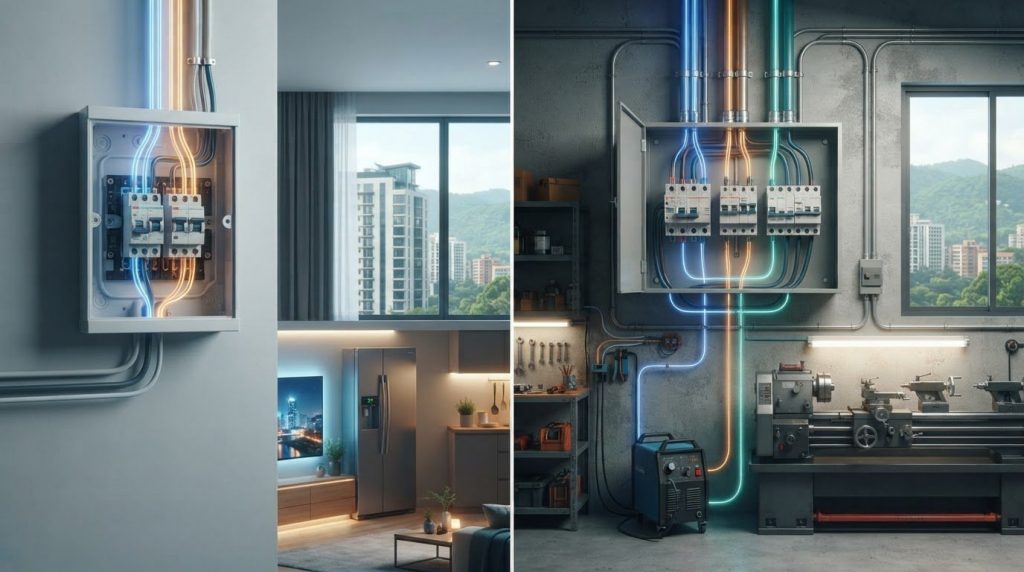
Single Phase vs Three Phase Meter: Compare Cost and Installation
The bigger meter isn’t automatically the better fit. In the single phase vs three phase meter comparison, the right choice follows the property’s electrical supply and connected load: a single-phase energy meter measures electricity on a two-wire system with one phase wire and one neutral, commonly supplied at 230 V and 50 Hz. Three-phase supply uses three live wires and is suited to higher electrical demand.
For a typical home or apartment in Nairobi, single-phase supply is usually sufficient for everyday appliances and low-to-moderate electricity use. Three-phase supply is more relevant when machinery, commercial equipment or several high-power systems need a larger, more evenly distributed load. The meter must match the supply configuration. Using the wrong type can result in inaccurate readings and billing errors.
This guide compares single phase vs three phase meter options by supply setup, power capacity, applications, cost and installation complexity. You’ll learn what to consider for a home, rental unit or business, and which details affect the decision in Kenya.
Key Takeaways
- Match the meter to the property’s electrical supply. A meter for the wrong phase can cause inaccurate readings and billing errors.
- Compare wiring and voltage before choosing: single-phase systems commonly use two wires, while three-phase systems distribute power across three live wires.
- Assess the connected equipment and load. Homes with typical appliances often suit single-phase supply; machinery and other high-demand equipment may need three-phase power.
- Factor in installation complexity as well as meter cost. Single-phase installations generally cost less, while three-phase setups involve a more complex supply configuration.
- Use the property’s distribution board and equipment requirements to guide the decision, then compare the meter options that match that setup.
What Is a Single-Phase Power and Its Features?
Electrical supply describes how power reaches a property and its distribution board. In Kenya, single-phase supply is standard for most residential connections. It uses one live wire and one neutral, with one fuse typically protecting the supply. This setup suits low-to-moderate electrical loads, including lighting, refrigerators, washing machines and televisions. A single-phase connection supports loads up to approximately 5-7 kVA and works best with equipment up to 5 horsepower.
Three-phase supply uses three live wires and a neutral, giving four conductors in total. Its three currents distribute electrical load across the phases, reducing the likelihood of overload-related outages. This configuration serves higher-demand premises running machinery, elevators, central air conditioning or industrial equipment. A three-phase supply is generally appropriate for loads greater than 5 horsepower. The property’s connected equipment, not the meter label alone, determines which supply configuration fits.
Check the existing electrical connection before selecting a meter. Look at the distribution board and identify whether the circuit is single-phase or three-phase. A single-phase submeter suits a unit with a single-phase distribution board; a three-phase submeter is required for a unit with three-phase distribution. Also list the appliances that may run at the same time. For example, when adding a high-power appliance, consider its load alongside existing lighting and household equipment.
Applying for an electricity connection involves paperwork and installation. Submit the electricity company’s required documents and pay applicable fees. The company then schedules the work, followed by inspection and installation. Keep the meter documentation with the property’s records. Document requirements depend on the application, so follow the electricity company’s instructions.
Compare the supply characteristics before making a choice:
| Supply option | Conductors | Typical voltage | Common fit |
|---|---|---|---|
| Single-phase | One live wire and neutral | 230 V at 50 Hz | Homes and low-to-moderate loads |
| Three-phase | Three live wires and neutral | 415 V | Businesses, machinery and higher loads |
Choose a meter that matches the existing supply and the equipment it will serve. A mismatch can lead to inaccurate readings and billing errors.
What is Single Phase Energy Meter?
A single-phase energy meter measures electricity used on a single-phase supply. In Kenya, single-phase supplies typically provide 220-240 volts. Three-phase supplies typically operate at 380-400 volts, and comparison tables also give 415 V as the standard three-phase voltage. Current capacity depends on the connection’s fuse rating. A three-phase supply typically has three 100amp fuses.
The meter records energy consumption; the supply configuration determines how electricity reaches the building. A single-phase meter measures a circuit using a phase conductor and neutral. A three-phase meter measures supply distributed across three phases and neutral. This difference affects the loads a building can run, including appliances, machinery and air conditioning. Match the meter to the supply, not voltage alone.
Compare the common voltage and wiring values:
| Supply | Typical voltage | Frequency | Configuration |
|---|---|---|---|
| Single-phase | 220-240 V | 50 Hz | One phase and neutral |
| Three-phase | 380-400 V | 50 Hz | Three phases and neutral |
| Three-phase comparison value | 415 V | 50 Hz | Three-phase supply |
The listed three-phase values use different comparison references. Check the voltage shown for the property’s supply and the meter’s rating. For a practical comparison, read the meter or supply documentation, then compare its voltage and phase configuration with the distribution board. A mismatch can lead to inaccurate readings and billing errors.
Voltage and current describe different parts of capacity. Voltage measures electrical potential; current, measured in amperes, indicates how much current the connection can carry. A fuse rating limits the current available through that connection. Three-phase supply commonly uses three 100amp fuses, one for each phase. The single-phase fuse rating determines its current capacity, so voltage alone doesn’t reveal how much equipment can run together.
Both supply types in these Kenya comparisons use 50 Hz frequency. That shared frequency doesn’t remove the voltage and wiring differences. For example, an appliance designed for a single-phase connection cannot be assumed to suit three-phase supply simply because both use 50 Hz. Check the appliance’s voltage and phase requirements against the building’s supply before connecting it.
For a building with air conditioning or machinery, check each item’s electrical rating and whether several loads run at once. Compare the combined demand with the supply configuration and fuse capacity. The meter should correspond to the existing supply, and the supply must support the equipment in use.
Meter cost and installation complexity
For a home or business in Kenya, compare the meter type and the work needed to connect it. Single-phase meters generally cost less to install and maintain than three-phase meters.
Meter Cost
A single-phase meter is usually the lower-cost option because it matches a simpler supply configuration. Three-phase submeters cost more, reflecting the additional phases they measure. Total project cost also depends on whether the existing supply matches the selected meter or needs changes. Costs vary by property.
Separate the meter cost from the cost of changing the supply. A household already connected to single-phase power avoids a supply conversion when choosing a compatible single-phase meter. A business with three-phase machinery needs a compatible three-phase meter. Choosing a single-phase unit to reduce upfront expense can lead to inaccurate readings and billing errors. The meter must match the circuit it measures.
Installation Complexity
Installation involves more than fixing a meter in place. The electricity company’s application process includes submitting required documents, paying fees, scheduling the work, inspection, installation and keeping the meter documentation. Three-phase work is more complex because the meter and circuit must correspond to all three phases. Existing wiring and the distribution board affect the work required.
Follow the process in order: apply to the electricity company, submit its required documents, pay applicable fees, then attend the scheduled work. Inspection and installation follow; retain the meter documentation afterward. These steps apply to the meter connection process, but they don’t mean every property needs a supply upgrade. An existing compatible circuit can avoid that extra work.
Before applying, note the supply type shown at the distribution board and list the equipment connected to it. A home with lighting and standard appliances has different requirements from a workshop running machinery. If the board is single-phase, a single-phase meter fits that circuit. If the unit has three-phase distribution, it needs a three-phase meter.
Costs and complexity can increase when the requested meter doesn’t match the current supply. For example, moving a business from single-phase to three-phase involves supply changes as well as meter installation. This can affect scheduling, inspection and the work required at the property. Replacing a meter with a compatible type avoids changing the phase configuration.
Compare the advantages with actual electrical demand, not the meter’s label alone. Three-phase supply suits higher-demand equipment, while single-phase is typically adequate for lower household loads. The key is whether the existing circuit supports the intended equipment and meter. This helps avoid paying for a more complex configuration without a corresponding power need.
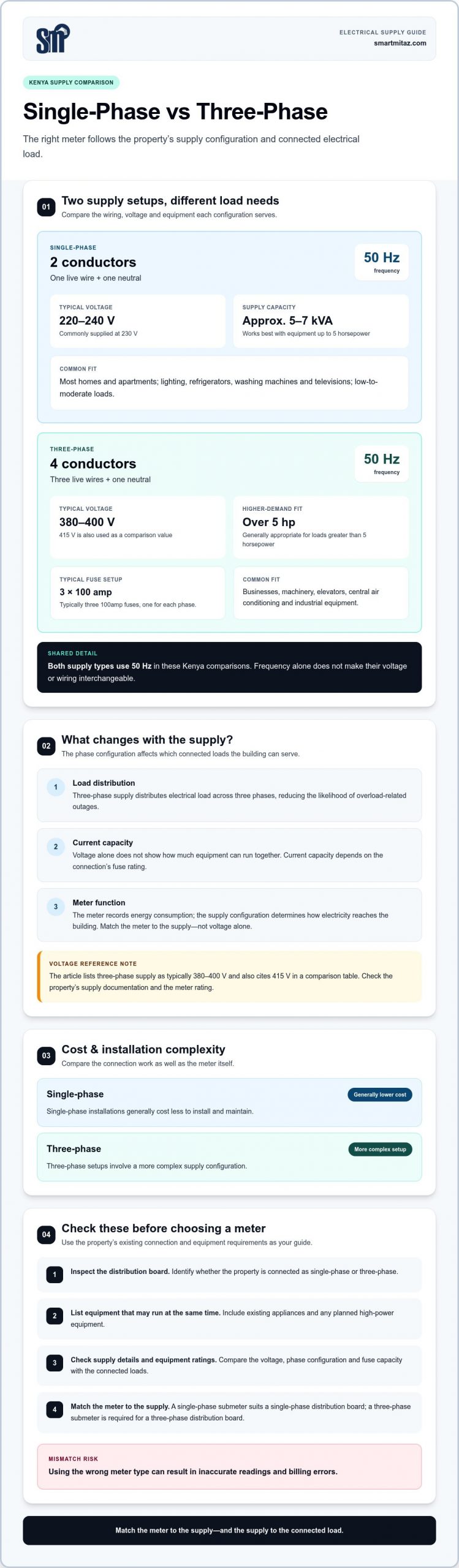
Single-phase and three-phase supply configurations
Supply configuration describes how electricity is distributed through a property and connected to its meter. The conductors and phase arrangement determine how the meter must measure consumption. In Kenya, identify the existing supply and distribution board before selecting a meter.
A single-phase connection typically has a phase conductor and neutral. The meter measures energy passing through that circuit, commonly recorded in kilowatt-hours (kWh). This setup suits apartments and other properties with lower electrical demand. A single-phase submeter also fits a unit whose distribution board has single-phase supply.
Three-phase supply uses three alternating currents, separated by 120 degrees. Its meter measures the phases serving the connected load, rather than treating the property as one single-phase circuit. The supply commonly has three phase conductors and one neutral. This arrangement supports higher electrical capacity and can distribute consumption across phases. Correct phase connections matter: connecting a meter intended for a different supply can produce inaccurate readings.
Star and delta describe ways of connecting three-phase windings or loads. In a star arrangement, one end of each phase connects to a shared point, which can provide a neutral connection. In a delta arrangement, the phases connect end-to-end in a closed loop. These configurations affect how power reaches equipment, but the meter’s wiring must still suit the supply and circuit being measured.
Meter wiring must match the actual supply configuration. A single-phase meter connects to the phase and neutral serving its circuit. A three-phase meter connects to the corresponding phase conductors and, where present, neutral. Terminal layouts vary by meter design, so follow the connection diagram. A three-phase submeter suits a unit with three-phase distribution, such as a commercial space running heavy-duty equipment.
Use this practical sequence to identify the required configuration:
- Read the supply and phase markings on the existing meter or property documentation.
- Inspect the distribution board for single-phase or three-phase breakers and conductors.
- Match the meter’s wiring arrangement to the circuit it will measure.
- Compare the connected equipment’s requirements with the supply configuration.
For example, an apartment with a single-phase board needs a meter suited to that circuit, even if another unit in the same building has three-phase supply. The building’s overall connection doesn’t automatically determine each unit’s configuration. Choose based on the individual supply, distribution board and intended consumption, then ensure the meter wiring matches.
Single-phase meter definition and applications
A single-phase meter measures electricity consumed through a single-phase connection. In Kenya, this setup is common in homes and apartments with low-to-moderate demand. Standard bedsitters and one- or two-bedroom units can use it for ordinary residential needs. The meter records household consumption, helping property managers track each unit’s electricity use separately.
Typical single-phase loads include lighting, televisions, refrigerators and washing machines. Small businesses with similar electrical demand can also use this configuration. The key is the connection: a single-phase submeter is appropriate when the unit’s distribution board has a single-phase supply. The meter should measure the circuit serving that unit, not the building’s total demand by assumption.
Three-phase supply is designed for premises with higher electrical demand. Machinery, elevators, industrial equipment and central air conditioning are examples of loads suited to three-phase power. Restaurants may need this setup for industrial ovens, large refrigeration units and commercial water heaters. Manufacturing tenants in commercial parks can also use three-phase submeters for industrial or heavy-duty equipment.
Some homes have heavier electrical loads. A penthouse or large home with multiple air conditioning systems and high-power appliances may need three-phase supply. The deciding factors are the equipment running together and its electrical demand, not whether the property is residential. For commercial spaces, assess the equipment mix and operating pattern before choosing a meter.
Motors need particular attention. Motors smaller than one kilowatt cannot run on single-phase power without additional equipment, such as a motor starter. This matters when a workshop is assessing whether its current connection supports a machine. Check the motor’s rating and connection requirements, then compare them with the supply available at the premises.
Use this practical application check:
- Residential: Match a typical home’s meter to its distribution board and household appliances.
- Small business: Consider the equipment and whether the loads resemble standard household use.
- Commercial kitchen: Account for industrial ovens, large refrigeration and commercial water heaters.
- Industrial or heavy-duty use: Assess machinery and motor requirements against the existing supply.
Three-phase supplies can support higher electrical demand, but capacity depends on the connection and installation. Treat this as a supply-capacity example, not a universal figure for every building. A restaurant, workshop or large residential unit should base its choice on actual equipment demand and distribution. Select a meter that matches the connection and supports accurate monitoring of the relevant load.
Smartmitaz: Outdoor 4G-LoRa water meter gateway
smartmitaz’s Outdoor 4G-LoRa water meter gateway is a relevant next step for properties considering water-meter monitoring alongside electricity metering. For electricity, choose a meter that matches the property’s supply: the Single Phase Smart Prepayment Meter or Three Phase Smart Prepayment Meter. The supply configuration determines which option fits.
For residential water metering, smartmitaz also offers the Residential Smart Prepayment Water Meter. These are metering products, not electricity or water supply services, and smartmitaz doesn’t provide meter installation or maintenance. Select based on whether you need electricity metering or residential water metering.
Explore the suitable metering options or contact smartmitaz to discuss your requirements.
Make the Meter Decision Your Next Practical Step
Turn the meter comparison into a clear procurement brief. Record the property’s supply type, the equipment the meter will serve and any planned additions. This gives you a practical basis for choosing a meter suited to its intended use, rather than choosing by price or label alone.
The single phase vs three phase meter decision also matters when planning prepaid electricity monitoring. smartmitaz offers a Single Phase Smart Prepayment Meter and a Three Phase Smart Prepayment Meter. For water monitoring, its range includes an Outdoor 4G-LoRa water meter gateway. Match the product category to the metering requirement before moving forward.
Use your requirements to guide the next step. Contact smartmitaz about your meter needs to explore the relevant metering option. A well-matched meter supports a more organized approach to property monitoring. Move ahead with a clear specification and choose the setup that fits your building.
Frequently Asked Questions
When Is a Three-Phase Submeter Needed?
A three-phase submeter is needed when the unit’s own distribution board and supply are three-phase. In Nairobi commercial buildings, this can apply to tenants operating industrial ovens, large refrigeration equipment, elevators or machinery. It also helps property managers measure an individual tenant’s consumption separately from other units. Base the choice on the tenant’s circuit and equipment, not just the building’s overall supply.
How Do I Know If My Property Is Single or 3 Phase?
Check the supply markings on the meter and distribution board, then compare them with the property’s electrical documentation. A single-phase board typically shows one phase connection; a three-phase board has connections for three phases. Don’t remove meter covers or handle conductors to identify them. In a Nairobi rental property, ask the building manager for the unit’s supply details if labels aren’t clear.
What Exactly Is a Phase?
A phase is one alternating-current path in an electrical supply. Single-phase power uses one alternating current, while three-phase power combines three currents separated by 120 degrees. This arrangement lets a three-phase supply distribute electrical demand across its phases. For example, a commercial building can allocate different loads across phases, while each tenant’s meter must still match the connection serving that tenant’s unit.
Where Are These Meters Used?
Single-phase meters are commonly used in homes, apartments and small businesses with modest electrical demand. Three-phase meters are used in larger commercial and industrial settings where equipment requires higher capacity. In Nairobi, a retail unit with basic lighting and office appliances may need a different configuration from a workshop operating machinery. Identify which premises or circuit the meter must measure.
Which Meter Does a Typical Apartment Need?
A typical Nairobi apartment with standard household appliances generally uses a single-phase meter, provided its unit connection is single-phase. Bedsitters and one- or two-bedroom units commonly fit this pattern. Apartments in Kenya typically consume between 50 and 200 kWh of electricity per month, but consumption alone doesn’t identify the supply type. Check the apartment’s own distribution board and meter markings before selecting a replacement.
Which One Should You Choose?
Choose a meter that matches the premises’ existing connection and the equipment it serves. To decide between a single phase vs three phase meter, check the distribution board, review appliance or machinery requirements, and consider whether loads run simultaneously. A small office with ordinary electronics may need a different setup from a Nairobi restaurant with commercial kitchen equipment. Keep the meter’s measurement scope clear, especially when separating tenant consumption.
What Is the Difference Between a Single-Phase and Three-Phase Electricity Meter?
The difference is the supply configuration each meter measures. A single-phase meter is designed for a single-phase circuit, while a three-phase meter measures a circuit supplied across three phases. This affects compatibility with the distribution board and connected equipment. For a property manager, the practical distinction is whether the meter records one unit’s household use or a higher-demand commercial circuit serving machinery or other heavy loads.
How Can I Tell Whether My Electricity Meter Is Single-Phase or Three-Phase?
Read the meter’s front label and inspect the distribution board markings without opening either enclosure. The label may identify the phase type, while the board can show whether the unit’s supply is single-phase or three-phase. Compare both with the unit’s electrical documents. In a Nairobi apartment block, don’t assume every unit has the same arrangement; individual units can have different connections.